
Quick answer: Getting recommended by ChatGPT, Perplexity, and Google AI Overviews comes down to six things: clear answers near the top of your pages, real facts an AI can quote, consistent business info across the web, content structured in plain headings and lists, fresh pages published regularly, and a way to check whether AI tools actually mention you. You don't need a marketing degree to do this — you need a checklist and 20 minutes a week.
Key takeaways
- AI answer engines pull sentences that stand alone and answer a question directly — vague intros get skipped, specific first sentences get quoted.
- Consistent NAP (name, address, phone) across your website, Google Business Profile, and directories is a documented trust signal that both traditional and AI search rely on.
- Publishing new, on-topic content on a regular schedule gives AI tools more recent material to pull from than a site that hasn't posted in a year.
- You can check your own AI visibility for free by asking ChatGPT or Perplexity questions a customer would ask and noting whether your business shows up.
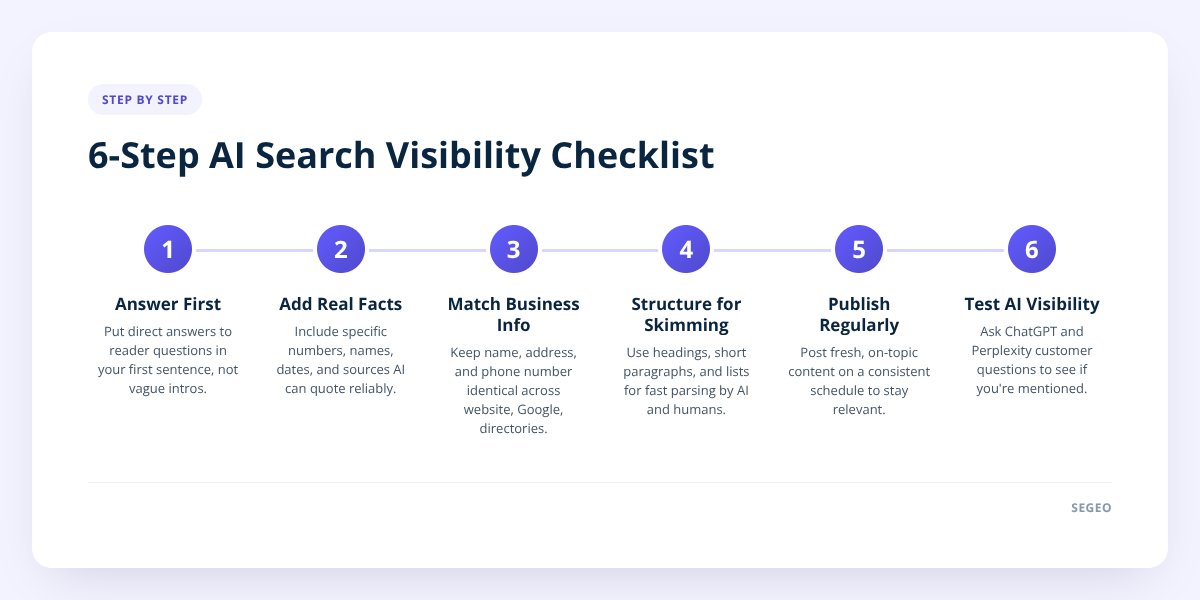
The 6-Step AI Visibility Checklist at a Glance
Here's the whole thing in one pass. Each step below gets its own section with specifics, but if you only have five minutes, this is what to walk away with.
- Step 1 — Answer first. Put the direct answer to the reader's question in the first sentence of every page or post.
- Step 2 — Add real facts. Include specific numbers, names, and sources an AI can quote instead of vague claims.
- Step 3 — Match your business info everywhere. Your name, address, and phone number should read identically on your site, Google, and every directory listing.
- Step 4 — Structure for skimming. Use headings, short paragraphs, and lists so both humans and machines can parse your content fast.
- Step 5 — Publish something new, regularly. A dead blog signals a dead business; a fresh post signals you're still active and relevant.
- Step 6 — Test yourself in the tools. Ask ChatGPT and Perplexity the questions your customers ask, and see if your name comes up.
Now let's break down why each one matters and how to actually do it without hiring anyone.
Why Does "Answer First" Matter So Much for AI Search?
Because large language models are built to extract self-contained answers, and a sentence that makes the reader wait gets passed over. When ChatGPT or Google's AI Overview answers a question, it's pulling short, complete chunks of text — not skimming your whole page for the gist. If your homepage says "Welcome to our family-owned business, serving the community since..." before ever answering what you actually do, that's a chunk with no answer in it.
Compare the two approaches:
| Weak opening | Answer-first opening |
|---|---|
| "At Smith Plumbing, we pride ourselves on quality service and customer satisfaction." | "Smith Plumbing fixes clogged drains, water heaters, and burst pipes in [service area], usually same-day." |
| "There are many factors to consider when choosing a dentist." | "The average cost of a routine cleaning runs $75–$200 depending on your location and insurance." |
| "Our team has years of experience helping clients like you." | "We handle small business bookkeeping for companies with 1–20 employees, starting at $300/month." |
The right-hand version gives an AI tool something to lift and attribute to you. The left-hand version gives it nothing to work with, so it moves on to a competitor's page that answered faster. We go deeper on this exact structural fix in How to Structure Content So Google and ChatGPT Both Get It.
What Counts as a "Real Fact" an AI Will Actually Quote?
A real fact is a specific, checkable detail — a number, a name, a date, or a documented rule — not an adjective. AI systems are trained to favor content that reads as trustworthy and specific, and vague marketing language ("industry-leading," "top-rated," "best in class") doesn't meet that bar because it can't be verified.
Things that qualify as quotable facts:
- Actual prices or price ranges, not "affordable rates"
- Named certifications, licenses, or years in business
- Specific service areas or zip codes covered
- Documented policies (return windows, warranty lengths, response times)
- Attributed statistics from a named source, like a trade association or government agency
If you're a home remodeler, "we use high-quality materials" tells an AI nothing. "We install GAF-certified roofing systems with a 25-year manufacturer warranty" gives it something concrete to repeat when someone asks which roofer to call.
Does NAP Consistency Really Affect AI Search Results?
Yes — mismatched business information across the web is one of the most common reasons a business gets skipped by both Google and AI assistants. NAP stands for name, address, and phone number, and it needs to match exactly everywhere your business appears online: your website footer, your Google Business Profile, Yelp, Facebook, industry directories, all of it.
Here's why this trips people up. A business might be "Smith Plumbing LLC" on its website, "Smith Plumbing" on Google, and "Smith Plumbing Inc." on an old Yelp listing. To a person, that's obviously the same company. To an algorithm cross-referencing listings to confirm a business is real and current, it can read as three different — or unreliable — entities.
Don't skip this: before you touch anything else on this checklist, spend 15 minutes checking your business name, address, and phone number across your website, Google Business Profile, and top directories. This is the single easiest fix on the list and one of the most overlooked.
How Should You Structure Content So AI Tools Can Read It?
Structure it the way you'd explain something to a busy coworker: short paragraphs, clear headings, and lists wherever you're naming more than a couple of options. AI crawlers and answer engines parse HTML structure — headings, bullet points, tables — to figure out what a page is actually about and where the useful parts live.
A few concrete habits:
- Use headings that ask real questions. "How much does X cost?" works better than "Pricing," because that's literally how people type questions into ChatGPT.
- Break up walls of text. Paragraphs longer than four or five lines get skimmed past by readers and are harder for AI to extract cleanly.
- Use tables for comparisons. If you're comparing services, timelines, or costs, a table beats three paragraphs of "on the other hand."
- Bold your key terms once. Defining an important term clearly, in bold, the first time it appears helps both readers and AI models recognize it as a core concept on the page.
If you want the fuller rundown of on-page elements — titles, meta descriptions, internal links — we laid it out step by step in The On-Page SEO Checklist Every Blog Post Needs.
Why Does Posting Regularly Matter More for AI Search Than It Used To?
Because AI answer engines favor content that looks current, and a blog with no new posts in eight months reads as inactive even if the old content is still accurate. Google has long used freshness as a ranking signal for time-sensitive topics, and generative engines lean on it too — they're more likely to surface a business that's clearly still operating and publishing than one whose last post is about a holiday sale from two years ago.
This doesn't mean you need to write every day yourself. It means the businesses showing up in AI answers tend to have:
- A steady publishing cadence instead of sporadic bursts
- Topics tied to what customers are actually searching right now, not a generic evergreen calendar
- Content that references current prices, current services, and current availability
One practical way to find topics worth writing about is to look at what people are already typing into your own site's search box or landing on by accident — we walked through exactly how to mine that data in Search Console Blog Topic Ideas: A Step-by-Step Guide. This is also where a tool like Segeo does the heavy lifting for non-marketers — it publishes a new, on-topic post to your site every day, pulled from live trend data and Search Console signals, so you're not stuck guessing what to write about at 9pm on a Tuesday.
How Do You Check If ChatGPT or Perplexity Already Recommend You?
Ask them, the same way a customer would. Open ChatGPT or Perplexity and type a question a real customer might ask — "best plumber in [your city]," "who does small business bookkeeping near me," "affordable dentist for a family of four" — and see what comes back.
Run through this quick self-audit:
- Ask 5–10 realistic customer questions across both ChatGPT and Perplexity
- Note whether your business name appears at all
- Check whether the details mentioned about you (hours, services, location) are accurate
- Search your business name directly in Google's AI Overview to see what summary appears
- Repeat this monthly, since AI-generated answers shift as models update and as your content changes
If you're not showing up anywhere, that's diagnostic information, not a dead end — it usually traces back to one of the first five steps on this checklist. We cover the specific reasons businesses get left out entirely in 8 Mistakes That Keep Businesses Out of AI Search Results, and if you want the fuller category explainer, What Is Generative Engine Optimization (GEO)? breaks down the discipline this whole checklist sits under.
None of this requires a marketing background — it requires consistency, specifics instead of adjectives, and a habit of checking your own results the way a customer would. If keeping up with the daily publishing part is the piece you don't have time for, that's the exact gap Segeo was built to close: it writes and publishes a new SEO post to your site every day, tracks whether AI tools are mentioning you, and hands you a 30-day content plan so you're never starting from a blank page. Check out Segeo's features to see how it fits into what you're already doing.
