
Quick answer: AI search optimization now means writing for at least four different answer engines — ChatGPT, Perplexity, Google AI Overviews, and Claude — because each one pulls information differently and cites different kinds of pages. The fix isn't four separate strategies; it's publishing clear, well-structured, frequently updated content that all of them can parse and trust. Businesses that post sporadically or write vague "about us" style content get skipped by every one of these systems, not just one.
Key takeaways
- Perplexity leans heavily on fresh, frequently-crawled pages, while Google AI Overviews pulls largely from pages already ranking well in traditional search — so the two reward different habits.
- A page needs clear headers, direct answers near the top, and specific facts (numbers, names, dates) to be quotable by any of these systems — vague marketing copy rarely gets lifted.
- You can see AI referral traffic starting to show up in Google Search Console and analytics tools as separate traffic sources, even though none of these platforms publish an official citation dashboard.
- Daily publishing builds the volume and freshness signals that all four platforms respond to — a single great post won't do what thirty consistent ones will.
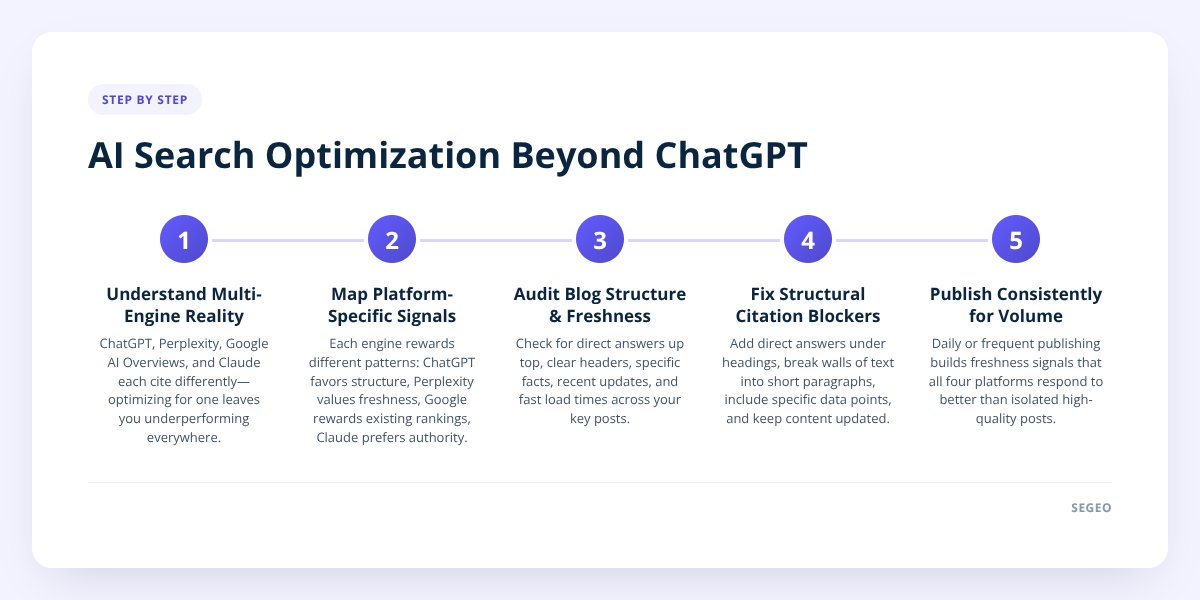
Step 1: Understand why ChatGPT-only optimization leaves you half-covered
If you've only been thinking about getting cited by ChatGPT, you're optimizing for one piece of a much bigger puzzle. Perplexity, Google AI Overviews, and Claude are all now common ways people search, and each one decides what to cite using a different process.
ChatGPT, when browsing is enabled, tends to pull from a mix of search results and its own training data, favoring pages that are clearly structured and topically focused. Perplexity is built around live web retrieval — it's constantly crawling and re-crawling, so recency matters more there than almost anywhere else. Google AI Overviews draws heavily from pages that already rank well organically, meaning traditional SEO fundamentals still carry weight. Claude, when connected to search tools, behaves more conservatively, often favoring sources that read as authoritative and well-sourced themselves.
The practical result: a page optimized purely for one engine's quirks can underperform everywhere else. We covered the ChatGPT-specific mechanics in How to Get Cited by ChatGPT: A Step-by-Step Guide, but that's step one of a bigger job, not the whole job.
Step 2: Stop treating citation patterns as one-size-fits-all
Each platform rewards a different kind of signal, and knowing which one matters where saves you from optimizing for the wrong thing.
| Platform | What it tends to favor | How to spot it working |
|---|---|---|
| ChatGPT | Clear structure, direct answers, topical depth | New referral traffic in analytics tagged from chat.openai.com or similar |
| Perplexity | Freshness, frequent crawling, specific facts | Referral traffic from perplexity.ai; spikes after a post updates |
| Google AI Overviews | Pages already ranking organically, strong on-page SEO | Impressions in Search Console for queries that trigger an Overview |
| Claude | Authoritative tone, well-sourced claims, conservative citations | Harder to detect directly; watch for referral domains tied to Anthropic tools |
None of these platforms publish an official citation report, so you're reading signals, not guarantees. Google Search Console is still your best free tool here — watch for impressions on question-style queries even when clicks stay flat, since that often means your page is feeding an AI Overview without the searcher clicking through.
Don't skip this: no SEO provider, including Segeo, can guarantee a citation in any AI tool or a specific Google ranking. Anyone who promises that outcome isn't being straight with you.
Step 3: Audit your blog for multi-platform discoverability
Run this check on your five most recent posts before writing anything new. Most small-business blogs fail on two or three of these without realizing it.
- Confirm each post answers its main question in the first two or three sentences, not buried in paragraph four.
- Check that every post has real headers (H2s, H3s) breaking up the content, not one unbroken block of text.
- Look for at least one specific fact per post — a number, a date, a named source — since vague generalities rarely get quoted.
- Verify your most important pages have been updated or re-published within the last few months, since Perplexity in particular favors recent crawls.
- Search your own business name plus your main service in ChatGPT and Perplexity to see if anything surfaces at all.
- Confirm your site loads fast and isn't blocking crawlers — a page an AI agent can't fetch can't be cited, period.
- Check Google Search Console's Performance report for queries phrased as questions, filtering for impressions with low click-through rate.
If most of your posts fail three or more of these checks, the problem isn't your writing quality — it's structure and frequency. That's a fixable, mechanical problem, not a talent problem.
Step 4: Fix the structural gaps that block citations
Once you know where the gaps are, the fixes are specific, not mysterious.
- No direct answer up top — Add a two-to-three sentence answer immediately under any heading phrased as a question. AI systems extract these almost verbatim.
- Wall-of-text formatting — Break paragraphs to three or four sentences max and add subheadings every 150–200 words so both readers and crawlers can scan structure.
- Vague claims with no specifics — Replace "we offer great service" with an actual number, policy, or named detail. Specificity is what gets lifted into an AI-generated answer.
- Stale content — Revisit cornerstone pages at least quarterly; Perplexity and similar tools weight freshness heavily in what they choose to cite.
- Missing local or industry context — Name your city, your actual service, and specifics about who you serve; generic copy reads as generic to an algorithm too.
This is also where keyword research for a small business owner gets easier, not harder: you're not guessing at search terms, you're fixing structural problems that apply no matter which keyword you eventually target.
Step 5: Match your publishing rhythm to how these platforms actually crawl
A single excellent post won't get cited consistently — publishing volume and frequency are themselves a signal, especially to platforms like Perplexity that reward recently-crawled, regularly-updated sites. We go deeper on the research behind this in How Often Should I Blog? Daily Beats Weekly for SEO, but the short version applies directly to AI search: a site that publishes daily gives every crawler — Googlebot, Perplexity's crawler, and OpenAI's — more recent, more specific material to pull from than a site that posts once a month.
This is also where doing it manually breaks down. Writing one genuinely useful, well-structured post a day, researching live trends for topics, and keeping every post distinct from the last 30 is a full-time content job on its own — most small-business owners don't have five extra hours a week for it, let alone five hours a day.
This is exactly the gap Segeo fills. It publishes a finished, on-topic post to your own website every day, pulling topics from live trend data and local-intent keywords for your industry so you never touch a keyword tool. Every post is structured so ChatGPT, Gemini, and Perplexity can cite it — not just Google — and it's checked against your last 30 posts so your blog builds real topical coverage instead of circling the same five ideas. You can see exactly what site structure supports this in LLM SEO: How to Rank in Google and Get Cited by AI at Once.
Step 6: Treat this as ongoing maintenance, not a one-time fix
AI search optimization isn't a project you finish — these platforms update their retrieval methods regularly, and a structure that works today may need adjusting in six months. Build a habit of checking Search Console monthly, re-reading your top five pages for staleness quarterly, and testing your own business name in two or three AI tools every so often to see what comes back.
If you want to see what consistently-structured, cited-ready posts actually look like in practice, we pulled together real examples in 3 Blog Post Examples That Rank in Google and Get Cited by AI.
What to do next
Start with the audit in Step 3 — it takes fifteen minutes and tells you exactly where your current content is losing citations before you write another word. From there, either commit to the daily structural work yourself or hand the mechanics to something built for it. Segeo's pricing starts from $89 a month, with everything — writing, research, images, publishing, and social — included in one plan, and a 14-day money-back guarantee if it's not the right fit.
Checklist: Auditing your blog for AI search optimization
- Read your last five posts and confirm each answers its core question in the opening sentences.
- Check that every post uses real H2 and H3 headers, not just bolded text pretending to be one.
- Find one specific, factual detail per post — a number, name, or date — and add one if it's missing.
- Check Google Search Console for question-style queries with impressions but few clicks.
- Search your business name and main service directly in ChatGPT and Perplexity to see what surfaces.
- Confirm your site isn't blocking crawlers and loads quickly on mobile.
- Set a recurring quarterly reminder to refresh your most important cornerstone pages.
- Compare your publishing frequency against your competitors' over the last 30 days.
