
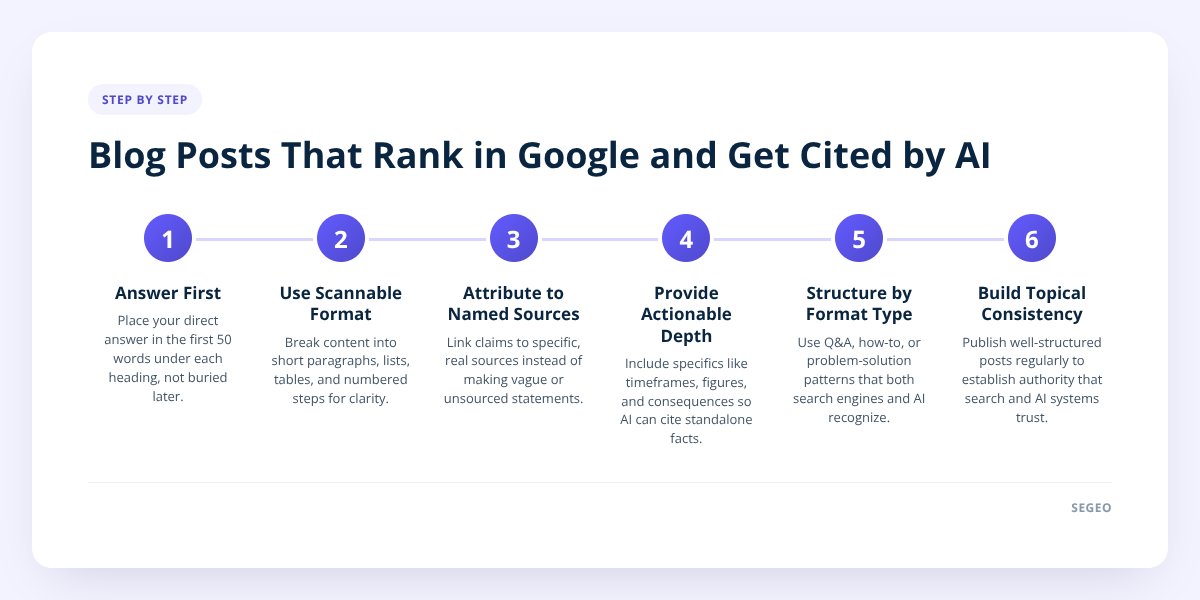
Quick answer: The blog posts that win both channels share three structural traits: a direct answer in the first 50 words, scannable formatting (lists, tables, short paragraphs), and facts attributed to named sources instead of vague claims. Below are three annotated post types — Q&A, step-by-step how-to, and problem-solution — showing exactly why Google can rank them and why ChatGPT, Perplexity, and AI Overviews pull sentences from them into answers.
Key takeaways
- Posts that get cited by AI assistants answer the question in the first sentence under the heading — not after three paragraphs of setup.
- Google and AI systems both reward scannable structure: short paragraphs, bulleted lists for anything with three or more items, and one table where comparison genuinely helps.
- Attribution matters more than polish — a sentence naming a specific, real source gets lifted into AI answers far more often than a confident but unsourced claim.
- Publishing one well-structured post occasionally won't build topical authority; consistency across weeks is what search engines and AI models learn to trust.
Why Most Blog Post Examples Only Solve Half the Problem
Most "how to write a blog post" guides were written for Google alone, and that advice is now incomplete. Ranking in Google rewards depth, keywords, and backlinks built up over months. Getting cited by an AI assistant rewards something else: a sentence that can be lifted whole, out of context, and still make sense.
Think about how ChatGPT or Perplexity actually answer a question. They're not sending a reader to your page to read the whole thing — they're scanning for a self-contained claim, often one or two sentences, that directly resolves the query. If your best information is buried in paragraph four behind a throat-clearing intro, it never gets picked up, no matter how well the page ranks.
That's the dual-channel problem. A post can rank on page one and still get zero AI citations, because ranking and citation are judged by different mechanics. We covered the underlying theory in LLM SEO: How to Rank in Google and Get Cited by AI at Once. This post is the practical companion — three real post structures, annotated line by line, so you can see exactly what to copy.
Example 1: The Q&A Structure
The Q&A format works because it mirrors how people actually type into search bars and chat windows — as a question. Here's a worked example for a local plumbing business:
H2: "How much does a water heater replacement cost?"
First sentence underneath: "A standard 40-gallon electric water heater replacement typically runs $1,200 to $2,500 installed, with gas units running higher due to venting requirements."
Why this works for Google: the H2 matches the exact query a person types, and the answer appears in the first sentence — satisfying what search engines look for when deciding whether a page deserves a featured snippet.
Why this works for AI citation: an assistant answering "how much does a water heater replacement cost" can lift that first sentence verbatim, with the business's name attached, because it's a complete claim that doesn't need the rest of the paragraph to make sense.
What breaks this pattern:
- Burying the number in the second paragraph after a story about a customer's basement flooding.
- Hedging with "it depends on a lot of factors" instead of giving a range immediately, then explaining the factors after.
- Writing the H2 as "Water Heater Costs" instead of the actual question — generic headings don't match query phrasing, so neither Google nor an AI model connects the two.
A strong Q&A post usually stacks four to six of these question-and-immediate-answer blocks, each its own H2. That's not a coincidence — it's the same shape AI Overviews use when they assemble an answer from multiple sources, which is part of why we broke down the mechanics in How to Structure a Blog Post for AI Overviews Optimization.
Example 2: The Step-by-Step How-To
A how-to post ranks well because Google can detect process clarity — numbered steps, each doing one job, in a logical order. But it gets cited by AI assistants for a different reason: actionable depth. The model needs enough specificity in each step that it can repeat the instruction without the reader needing to click through.
Here's what separates a how-to that gets cited from one that doesn't:
| Weak version | Cited version |
|---|---|
| "Gather your documents" | "Gather your last two pay stubs, a government ID, and your most recent bank statement" |
| "Set up your account" | "Create an account using a business email address, not a personal one — this avoids verification delays" |
| "Wait for approval" | "Approval typically takes 3 to 5 business days; most denials are due to a mismatched address on file" |
The right column works because each line is a complete, standalone fact. Strip it out of the post entirely and it still reads as useful, correct information. That's the exact test AI systems apply when deciding what to quote.
A good step-by-step post also names what goes wrong at each stage, not just what to do right. If step 4 is "submit the form," the version that gets cited also says what happens if the form gets rejected and why — because that's the follow-up question a real person asks next, and increasingly, the follow-up question an AI assistant anticipates in the same answer.
Don't skip this: if your how-to post has a step with no number attached — no timeframe, no dollar figure, no quantity — rewrite that step before you publish. Vague steps don't get cited; they get skipped.
Example 3: The Problem-Solution Post
The problem-solution format starts with the pain, not the fix — but the fix still has to show up fast. Here's the shape that works:
H2: "Why won't my sink drain even after I used a plunger?"
First sentence: "A sink that won't drain after plunging usually means the clog is past the trap, in the branch line — plunging only clears blockages in the trap itself."
That one sentence does three jobs at once: it validates the reader's frustration (the plunger didn't work, and here's why), states a fact, and sets up the actual solution that follows. AI assistants favor this structure because the query that triggers it — "why didn't plunging work" — is itself a problem statement, and the answer mirrors that phrasing back.
What searchers ask versus what chatbots recommend often diverges slightly, and that gap is where problem-solution posts earn their keep:
- A searcher types the symptom ("sink won't drain after plunging").
- A chatbot, asked the same question, often adds a safety or cost caveat the searcher didn't ask for ("before calling a plumber, check if it's a shared line with a neighbor").
- The posts that get cited are the ones that already included that caveat, because the model doesn't have to invent it — it just repeats what's already written.
This is also where attribution earns its keep. A line like "according to the Environmental Protection Agency, pouring grease down a drain is a leading cause of municipal sewer blockages" is far more citable than "grease is bad for your pipes," because it's specific, sourced, and quotable on its own. We go deeper on sourcing mechanics in How to Get Cited by ChatGPT, Perplexity, and Claude.
How to Adapt These Structures to Your Own Industry
Adapting these three formats to your business is mostly a matching exercise: pick the format based on how your customers actually search, not which one looks easiest to write. A dentist gets more mileage from Q&A ("does teeth whitening hurt?") than from problem-solution. A landscaper gets more from how-to ("how to overseed a lawn in fall") than from Q&A alone. Most small business blogs need all three in rotation, not just one.
Where this breaks down for almost every small business owner isn't the writing — it's the schedule. Knowing the structure is one afternoon's work. Producing a new, correctly structured post, in your voice, about a topic your actual customers are searching for, every single day for a year, is a different problem entirely. That's the point where most blogs stall out at six posts and go quiet.
This is the specific gap Segeo is built to close. It writes and auto-publishes one finished post to your own website every day — not a draft waiting in a queue — choosing each topic from live trend data and real local-intent keywords for your industry, so you're never staring at a blank page deciding what this week's post should be about. It learns your voice from your own site at setup, names your business and a real service you offer in every post, and checks each new topic against your last 30 posts so you build genuine topical coverage instead of circling the same five ideas. Every post is structured the way the three examples above are structured, so it's built to be picked up by ChatGPT, Gemini, and Perplexity, not just ranked by Google.
If you want to see what a week of this looks like before committing, the full breakdown of connection options and what publishing actually looks like day to day is on the docs page; pricing starts from $89 a month, detailed on the pricing page.
What to Do Next
Pick one of the three formats above and apply it to a question your last five customers actually asked you. Write the H2 as that exact question, answer it in the first sentence, and build the rest of the post around supporting detail — not the other way around. Do that consistently, and both channels start working in your favor instead of you choosing one over the other.
Ready to put this on autopilot? Segeo turns this exact structure into a daily habit for your site, with full control to edit, regenerate, or unpublish anything before it goes live.
Checklist: Writing a Blog Post That Ranks and Gets Cited
- Write the H2 as the exact question a customer would type or ask a chatbot.
- Answer that question in the first sentence underneath it — no setup, no "it depends" without a number attached.
- Add a number, date, or named source to every claim that could otherwise sound vague.
- Convert any list of three or more items into actual bullets, not a run-on sentence.
- Build one table only if you're comparing options, costs, or timelines side by side.
- Bold the key term the first time you define it — sparingly, not every line.
- Read each paragraph and ask if it could stand alone if an AI model quoted only that sentence.
- Check your last 30 posts before picking a new topic so you're building coverage, not repeating yourself.
