
Quick answer: LLM SEO means writing content so that both Google's algorithm and AI systems like ChatGPT, Perplexity, and Google's AI Overviews can find it, understand it, and quote it. You don't need five separate strategies for five platforms — one well-structured, fact-dense, regularly published blog post can satisfy all of them, because they're all looking for the same basic signals: clear answers, real expertise, and freshness.
Key takeaways
- Search is no longer one channel — Google AI Overviews, ChatGPT, Perplexity, Gemini, and Claude now each send customers to small-business websites, often without a click.
- The same content structure that ranks in classic Google search — a direct answer up top, clear headings, specific facts — is what gets pulled into AI-generated answers too.
- Posting on a schedule matters more under fragmentation, not less, because AI models favor sources that show ongoing, current activity over a single old page.
- Traffic numbers alone no longer tell the full story; citations, brand mentions inside AI answers, and referral visits from AI tools are becoming real metrics worth tracking.
Where do customers actually search now?
Customers looking for a small business today might type into Google, ask ChatGPT, search Perplexity, or just read the AI Overview that Google shows before any regular results. That's five distinct discovery paths — Google search, Google's AI Overviews, ChatGPT, Perplexity, and increasingly Gemini or Claude — and a business that's optimized for only one of them is invisible on the other four.
This is a real shift in behavior, not a hypothetical one. AI Overviews now appear above traditional results for a large share of Google searches, which means a business can technically "rank" and still get zero clicks if its content isn't the one summarized at the top. Meanwhile, more people are skipping Google entirely and asking ChatGPT or Perplexity for recommendations directly — tools that answer in plain sentences and cite a small handful of sources per question.
Here's the part that trips up a lot of small-business owners: these platforms aren't separate silos with separate rulebooks. They pull from overlapping data. Google's crawler still indexes your site. AI models are trained on and retrieve from web content, much of it surfaced the same way search engines have always surfaced it — by finding pages that clearly answer a specific question. The fragmentation is real, but the fix isn't fragmented.
Why "SEO" alone doesn't cover this anymore
Traditional SEO optimizes for one thing: getting a blue link to rank high on a Google results page. That's still useful, but it's no longer the whole job. AI visibility is the newer, broader goal — making sure your business shows up correctly when an AI assistant answers a question a potential customer asked it, whether or not that turns into a click.
The difference matters because the two goals reward slightly different things:
| Goal | What it optimizes for | What earns it |
|---|---|---|
| Classic SEO ranking | Position on a Google results page | Backlinks, keyword targeting, page speed, site structure |
| AI search visibility | Being the source an AI model cites or paraphrases | Clear direct answers, specific facts, named sources, structured formatting |
Notice there's a lot of overlap — page structure and clarity help both. But AI visibility puts extra weight on things classic SEO checklists often skip: answering the question in the first sentence, stating facts plainly enough to quote, and citing real sources instead of vague claims. We go deeper on the mechanics of this in LLM SEO Explained: How AI Models Read Your Content.
Don't skip this: if your homepage or blog buries the answer to a common customer question three paragraphs deep, neither Google's AI Overview nor ChatGPT is likely to dig for it — they'll cite a competitor who put the answer in the first sentence instead.
What one blog post structure needs to satisfy Google and AI at once
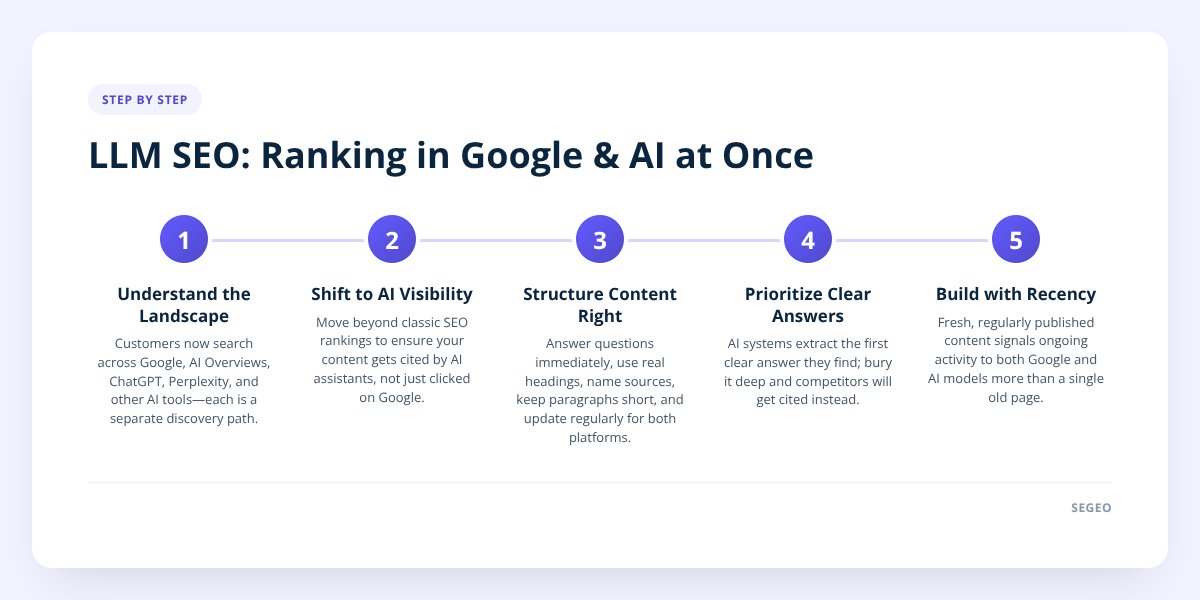
One structure works for both, and it comes down to five habits repeated in every post:
- Answer the question immediately. Put the direct answer to the implied question in the first sentence of the section, not the fourth paragraph. AI systems extract the first clear answer they find; skimming humans do the same thing.
- Use real headings that ask real questions. A heading like "How much does a plumber charge for a water heater install?" gets matched against actual search queries and actual AI prompts. A heading like "Our Services" matches nothing.
- Name your sources. A sentence like "the IRS sets the standard mileage rate annually" is quotable and citable. A sentence like "experts say rates change often" is not — it has nothing an AI model can safely repeat as fact.
- Keep paragraphs short and scannable. Both Google's crawler and AI retrieval systems favor content that's easy to parse into distinct chunks — short paragraphs, bullet lists, and tables all make that job easier.
- Update or add content regularly. A single well-written page from a year ago competes against dozens of fresher pages published this week. Recency is a signal both systems weigh.
Where the two diverge is subtle. Classic Google ranking still rewards backlinks and domain authority — signals that take time to build and that AI citation doesn't require nearly as much. An AI assistant will happily cite a small, low-authority site if that page answers the specific question clearly and states its facts plainly. That's actually good news for small businesses: you don't need years of link-building to get quoted by ChatGPT, you need a clear, well-sourced answer. We covered the citation mechanics in detail in How to Get Cited by ChatGPT, Perplexity, and Claude.
Does posting more often actually help, or is that just busywork?
Publishing consistently helps more under fragmentation than it did with Google alone, because you're no longer trying to win one algorithm's favor — you're trying to stay visible across several systems that each refresh their sense of "who's current" on their own schedule. A single great post from six months ago might still rank fine in classic Google search, but AI models pulling live or recent web data tend to favor sources showing ongoing activity over a business that posted once and went quiet.
Think about what happens when a customer asks ChatGPT or Perplexity a timely question — "who does emergency HVAC repair near me" or "what's a fair price for a kitchen remodel this year." These tools weigh recency heavily for anything time-sensitive. A business with a blog post from last September answering last year's version of that question is competing against businesses answering this week's version.
This is where daily publishing stops being overkill and starts being the actual strategy. It's also exactly the gap Segeo was built to close — it writes and auto-publishes a fresh, on-topic blog post to a business's site every day, with topics pulled from live trend and news data instead of a recycled content calendar, so the business always has something current to be cited from. We've written more on the cadence question itself in How Often Should I Blog for SEO and AI Search in 2026?
The math is simple even if you're doing it by hand: one post a month gives you 12 chances a year to be the source an AI model or Google picks. One post a day gives you well over 300. Neither guarantees a citation — nothing does — but volume plus quality beats quality alone when the finish line keeps moving across five different platforms.
How do I know if it's working when traffic comes from five places?
Traditional analytics undercount success now, because a citation in an AI Overview or a ChatGPT answer often generates zero click and zero pageview — but it still puts your business name in front of a customer. Measuring only Google Analytics traffic will make a genuinely effective content strategy look like it's failing.
A more honest measurement approach tracks a mix of signals:
- Referral traffic from AI platforms. Check your analytics for visits attributed to chatgpt.com, perplexity.ai, or similar sources — these show up as distinct referrers now, not just "direct" traffic.
- Google Search Console impressions and queries. Even without AI-specific tools, a rise in impressions for question-style queries suggests your content is being surfaced in AI Overviews, which typically pull from top-ranking organic content.
- Brand mention checks. Periodically ask ChatGPT or Perplexity a question your business should answer — "who's a good [service] in [your area]" — and see if you're named. This is manual, but it's the most direct read on AI visibility you can get today.
- Direct traffic and branded search upticks. If more people are searching your business name directly after seeing it mentioned in an AI answer, that shows up as a branded-search increase even when the original citation drove no click.
- Time-on-page and scroll depth for blog content. These still matter for classic SEO ranking signals and tell you whether the humans who do click are actually finding what they came for.
No single number tells the whole story anymore, which is why tools built for this era — including the AI-visibility tracking built into Segeo — try to combine Search-Console data with citation checks rather than reporting traffic alone. If you're deciding how to build content for both systems from scratch, our piece on How to Write SEO Content That Ranks and Gets Cited by AI walks through the writing process step by step.
Search fragmenting across five platforms sounds like five times the work. In practice, it's the same work — clear answers, real sources, consistent publishing — done once and pointed everywhere at the same time. The businesses struggling right now are mostly the ones still writing for a Google that no longer works alone, not the ones without enough hours in the day.
If keeping up with daily, cross-platform publishing isn't realistic on top of running the business itself, that's the exact gap Segeo is built for — a blog post every day, written in your voice, aimed at both the search box and the chatbot, from $89/month.
Checklist: Building One Content Strategy for Google and AI Search
- Audit your last five blog posts and check whether the direct answer appears in the first sentence of each section.
- Rewrite any vague claims to name a specific source, number, or date.
- Add clear, question-style headings to any page that currently uses generic labels like "Services" or "About."
- Set a realistic publishing cadence and commit to it for at least 90 days before judging results.
- Add Search Console to your site if it isn't connected, and check impressions for question-style queries monthly.
- Manually ask ChatGPT and Perplexity a question your business should answer, and note whether you're mentioned.
- Track referral traffic from AI platforms separately from your regular analytics dashboard.
- Review one older, high-traffic page and update it with a current date, fact, or example.
