
Quick answer: Automated blogging software wins because it solves the one thing that kills most small business blogs: inconsistency. A human-run blog averages a handful of posts before it stalls out from being busy; automation publishes on schedule every single day, which is the frequency threshold that actually moves search rankings and AI citations. The quality gap people worry about is manageable with voice-matching and review controls — the silence gap from a stalled blog is not.
Key takeaways
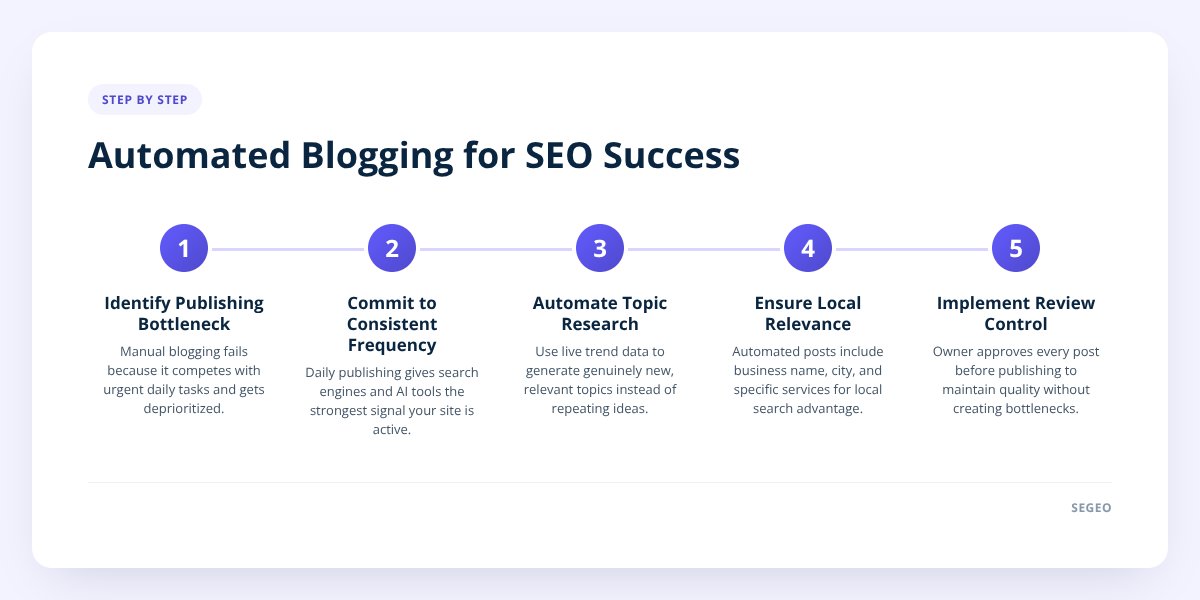
- Most manually run small business blogs go dormant within the first few months — not from lack of ideas, but because blogging is always the first task cut when the owner gets busy.
- Google has repeatedly said there's no minimum publishing frequency required to rank, but search engines can only index and re-crawl content that actually gets published — a blog with one post from eight months ago gives them nothing new to work with.
- Tools like Segeo publish a complete, on-topic post to the business's own site every day, using topic selection drawn from live trend data so the content stays relevant instead of repeating the same five ideas.
- Review mode lets an owner approve every post before it goes live, which removes the "robot wrote something embarrassing" risk without bringing back the bottleneck that stopped manual blogging in the first place.
Why do most small business blogs go silent after a few posts?
Because blogging competes with everything else on an owner's plate, and it always loses. A plumber, a dentist, a boutique owner — nobody opens their day thinking "today I'll write 800 words about my industry." They think about the customer on hold, the invoice that's late, the shipment that didn't arrive.
Blogging gets scheduled for "when things slow down." Things never slow down. So the blog that started strong with three posts in the first week quietly stops, and nobody circles back to apologize to it.
This isn't a motivation problem. It's a bottleneck problem. Manual blogging requires the same person to repeatedly do four separate jobs — come up with a topic, research it, write it well, and actually hit publish — and any one of those four steps breaking is enough to stop the whole chain. We've seen this pattern described in detail in Why Your Small Business Blog Isn't Ranking: it's rarely a writing-quality problem. It's almost always a stopped-publishing problem.
The fix isn't "try harder" or "block off Friday mornings." It's removing the human bottleneck from the steps that don't require a human — topic research, drafting, and the physical act of publishing — so the only thing left for the owner to do is glance at it.
How often should I blog for SEO to actually matter?
Daily publishing gives search engines and AI tools the strongest, most frequent signal that a site is active and worth re-crawling — but there's no official minimum, and consistency matters more than any specific number. Google's own guidance, published through its Search Central documentation, does not set a required posting frequency. What Google has said repeatedly is that it rewards fresh, useful content and re-crawls active sites more often than dormant ones.
That's the part people miss. It's not that Google punishes a once-a-month blog. It's that a once-a-month blog simply gives Google (and ChatGPT, and Perplexity, and Google's AI Overviews) far fewer chances to find something worth surfacing. Every published post is a new entry point — a new question it can answer, a new keyword phrase it can match, a new page an AI assistant can pull a sentence from when a user asks a related question.
| Publishing pattern | New entry points per month | What it signals |
|---|---|---|
| A few posts, then silence | 0 after the first month | Site looks abandoned to crawlers |
| Weekly | ~4 | Active, but slow to build topic coverage |
| Daily | ~30 | Continuously fresh, broad topic coverage fast |
We go deeper into the actual math behind this in How Often Should I Blog? Daily Beats Weekly for SEO. The short version: thirty posts a month covering thirty different angles on your industry gives an AI assistant thirty different chances to find a sentence worth quoting. One post, however well-written, gives it one.
What does automated blogging catch that a busy owner won't?
Automation doesn't forget, doesn't deprioritize, and doesn't run out of ideas — three things that quietly end most manual blogging efforts. Specifically, here's what tends to slip when a human is doing it all manually:
- Publishing on the days it's inconvenient. The blog post scheduled for the Monday after a holiday weekend is the first thing that gets skipped.
- Picking a genuinely new topic. After a dozen posts, most owners start circling the same three ideas because coming up with fresh angles is the hardest part of the job.
- Checking what's already been covered. Without a system, it's easy to write "5 Tips for Spring Maintenance" twice, eighteen months apart, and not notice.
- Keeping local relevance in every post. It's easy to write generically and forget to mention the city, the neighborhood, or a specific service by name — details that matter for local search.
- Cross-posting to other channels. A blog post that could've become an Instagram carousel just sits on the website, unseen by anyone who doesn't visit directly.
Segeo's daily engine is built around closing exactly those gaps. Topics come from live trend and news data for the business's industry — not a recycled content calendar — and every new topic gets checked against the last 30 posts so the blog builds real coverage instead of circling the same five ideas. Every post names the business, its city, and a real service it offers, and the same engine turns into branded Instagram carousels and reels, cross-posted to LinkedIn. A daily email tells the owner exactly what went live and why.
Don't skip this: a blog that publishes once and then goes quiet for months does less for your SEO than no blog at all — it signals to both Google and AI crawlers that the site isn't actively maintained.
Will auto-published content sound robotic or hurt my brand?
Not if the tool is built to match your actual voice, and not if you keep a human review step for anything that worries you. These are the three fears we hear most, and each has a concrete answer:
"It'll sound like a robot wrote it." This is solvable by having the software learn tone from the business's own existing website at setup, rather than writing in a flat, generic style. Segeo extracts brand voice directly from the customer's site before it writes a single post.
"I'll lose control of what goes out under my name." You don't have to. Review mode means nothing publishes until you approve it, and any post can be edited, regenerated, or unpublished at any time — the same control you'd have writing it yourself, minus the hours it takes to get there.
"Google will treat it as spam." Google's publicly stated policy, per its Search Central spam guidelines, is that it penalizes content produced primarily to manipulate rankings — regardless of whether a human or a machine wrote it — not automation itself. The distinguishing factor Google names is usefulness to the reader, not the tool used to produce it. A genuinely useful, on-topic post published by software isn't treated differently from one typed by hand; a thin, repetitive post is a problem whoever wrote it.
If you want the deeper mechanics of what makes AI tools like ChatGPT actually cite a page instead of your competitor's, that's covered in How AI Overviews Choose Small Business Blogs.
Should automation replace manual blogging entirely, or work alongside it?
For most small businesses, automation should be the baseline — the thing that guarantees a post goes out every day — with manual writing reserved for the handful of pieces that genuinely need a personal story only the owner can tell. Think of it less as "automation versus manual" and more as division of labor:
- Let automation handle: the daily cadence, trend-based topic selection, local SEO details, keeping coverage broad, and the social cross-posting that never happens manually anyway.
- Save manual writing for: a founder's personal story, a detailed case study with real client permission, or a announcement that needs a specific human voice behind it.
The mistake is treating these as competitors. An owner who insists on writing every post by hand is optimizing for perfectionism on a handful of posts a year, while the blog goes silent the other 350 days. An owner using daily automation as the floor — and adding a personal post whenever they actually have something to say — gets both consistency and the occasional human touch that lands harder.
If you're trying to decide between tools or figure out what "automated blogging software" should actually include before you commit, How to Choose a Blog Automation Tool That Actually Works walks through the checklist in more depth.
Setting up a daily publishing engine like Segeo takes about five minutes — connect WordPress with one application password, or link up Wix, Shopify, or a custom site through a Git repo — and then it runs on its own, with a receipt email every day showing exactly what went live. Plans start from $89 a month; see current pricing at segeo.net/pricing.
Checklist: Switching from manual to automated blogging
- Audit your current blog's publishing gaps — note the longest stretch of silence in the last year.
- List the local details (city, neighborhood, specific services) your past posts have been missing.
- Decide which platform you're on — WordPress, Wix, Shopify, or a custom site — before choosing a tool.
- Set up voice-matching by pointing the tool at your existing website content.
- Turn on review mode for your first two weeks so you can approve posts before they go live.
- Check new topics against your last 30 posts to confirm you're not repeating yourself.
- Pick one or two post types you still want to write personally, like founder stories or case studies.
- Review your daily receipt email for the first month to confirm topics and tone are on target.
