
Quick answer: Google's AI Overviews pull from pages that show clear, current expertise on a narrow topic, back up claims with specifics, and are structured so an answer engine can lift a self-contained sentence without rewriting it. Keyword matching alone doesn't get you picked — freshness, topical depth, structural clarity, and whether other AI models already cite you all factor in. You can audit for each signal yourself, and three changes (publishing consistently, writing answer-first, and tightening your facts) can move a small blog into contention within about a month.
Key takeaways
- AI Overviews favor pages with a direct answer in the first sentence or two, not pages that build up to the point.
- Posting once a month signals a dormant site to crawlers; sites that publish several times a week tend to get recrawled and reconsidered more often, per Google's own guidance on crawl frequency.
- Topical authority comes from covering a subject from many angles over time, not from one long "ultimate guide" post.
- Structural clarity — short paragraphs, labeled lists, clear headings — matters because AI systems extract and summarize text; it's not a cosmetic choice.
Why Do Some Small Business Blogs Get Featured in AI Overviews and Others Don't?
It's not about who used the keyword the most times. Google has said publicly that AI Overviews are generated using the same core ranking systems as regular Search, which means the page still has to earn relevance, quality, and trust signals first — the AI summary layer just decides how to present and attribute what's already deemed worth showing.
That explains why a three-year-old blog with one post a month often loses out to a newer blog that publishes constantly on narrow, specific topics. The older blog may have more total content, but the newer one looks active, current, and focused — three things both Google's ranking systems and large language models weigh when deciding what to cite.
There's also a difference between ranking and being quoted. A page can rank on page one and still never get pulled into an AI Overview, because the overview isn't picking the "best" page overall — it's picking the page with the cleanest, most extractable answer to the specific question being asked. That's a structural problem as much as an SEO one, and it's one we unpacked in why your blog posts aren't showing up in AI Overviews.
The 5 Signals That Decide Whether Your Blog Gets Picked
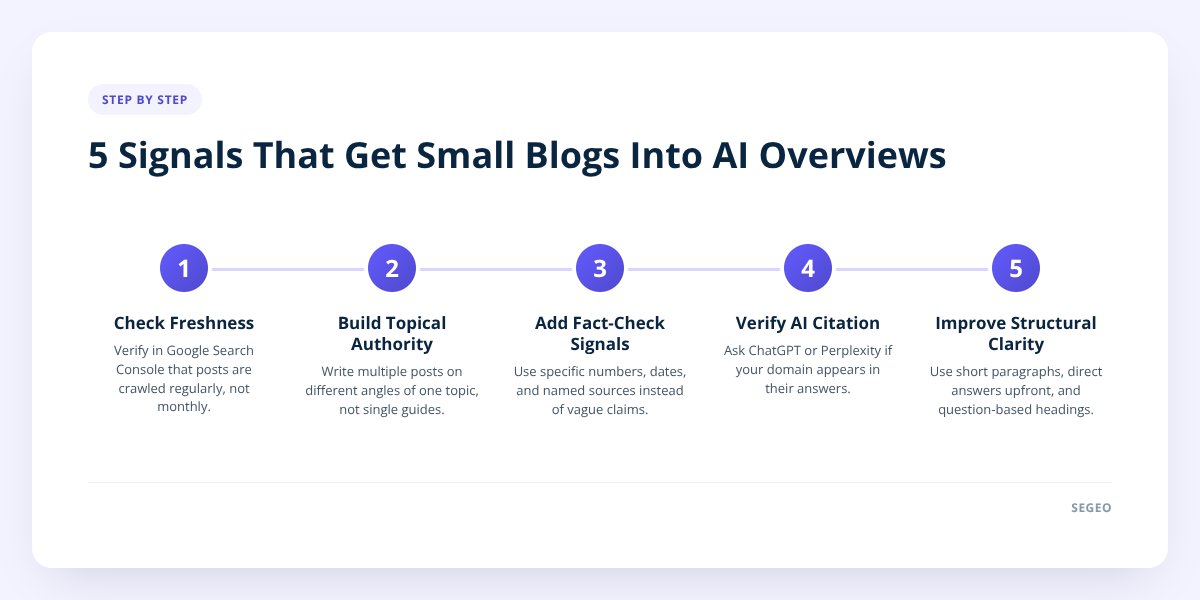
Reverse-engineering AI Overview selection isn't guesswork — it comes down to five observable signals you can check on your own site today.
- Freshness. Recently updated or recently published content gets reconsidered more often. Google's documentation on crawling and indexing confirms that sites publishing regularly tend to get crawled more frequently, which puts new content in front of ranking systems faster.
- Topical authority. A blog that's written fifteen posts about, say, HVAC maintenance from different angles (seasonal tune-ups, filter sizing, thermostat errors, warranty terms) reads as more authoritative on HVAC than a site with one 4,000-word "complete guide" and nothing else.
- Fact-check signals. Specific numbers, named sources, and dates that can be verified make a page safer for an AI system to quote. Vague claims ("many experts agree") get passed over because there's nothing to attribute.
- Citation by other AI models. If ChatGPT or Perplexity is already citing a page, that's an external signal of trustworthiness that can reinforce how other systems treat the same domain. Pages structured for one AI system to lift tend to work for others too — the overlap is bigger than most people assume.
- Structural clarity. Short paragraphs, direct answers near the top of a section, and clearly labeled lists make a page easy to extract from. A wall of text forces the AI to do more interpretive work, and it will often choose a competitor's cleaner page instead.
Don't skip this: none of these signals work in isolation. A perfectly structured post on a blog that hasn't published in six months still loses to a slightly rougher post on a blog that updates daily. Freshness is the multiplier on everything else.
How to Audit Your Own Blog for Each Signal
You can check most of this in under an hour using tools you probably already have.
For freshness, open Google Search Console and look at the Pages report under Indexing. Check the "last crawled" date on your most important posts — if it's been weeks, that's a sign Google isn't prioritizing your site for recrawling, usually because publishing has slowed or stopped.
For topical authority, list every blog post title from the last six months in a spreadsheet and group them by subtopic. If most of your posts cluster around one or two ideas repeated with different titles, you have thin coverage, not deep coverage. Real topical authority means dozens of distinct angles on the same core subject.
For fact-check signals, reread your last five posts and count how many sentences include a specific number, date, or named source versus how many use vague qualifiers like "many" or "often." A page an AI model can quote directly needs sentences that stand alone and carry a verifiable claim.
For citation by other AI models, ask ChatGPT or Perplexity a question your blog answers and see if your domain shows up in the response or its sources. This is slow to check manually, which is part of why tracking AI-driven visibility over time matters more than checking once.
For structural clarity, look at your average paragraph length and whether your H2s are questions or generic labels. A heading like "Our Services" tells an AI system nothing; a heading phrased as a real question gives it something to match against. We broke down the mechanics of this in how to structure a blog post for AI Overviews optimization.
The 3 Changes That Can Move a Small Blog Into Contention in 30 Days
Three changes, applied consistently, tend to produce visible movement within about a month — not a guarantee, but a realistic window based on how often Google recrawls actively updated sites.
- Publish on a real schedule, not a calendar of leftovers. Going from monthly to several posts a week changes how often your site gets recrawled and how much fresh material search and AI systems have to evaluate. This is the single highest-leverage change on the list.
- Rewrite your openings to answer first. Take your five most-visited posts and rewrite the first sentence under each heading so it directly answers the question in that heading, before any setup or story. This alone can make existing content more extractable without writing anything new.
- Add specifics you can attribute. Replace vague claims with a number, a date, or a named source wherever you can confirm one. If you're citing an outside fact, name the organization that published it — that's what makes a sentence safe for an AI system to lift as-is.
Here's how those three changes compare in terms of effort versus what they typically affect:
| Change | Effort | What it mainly affects |
|---|---|---|
| Publish more frequently | Ongoing, moderate | Freshness, crawl frequency |
| Answer-first rewrites | One-time, low | Structural clarity, extractability |
| Add attributed specifics | Per-post, low | Fact-check signals, trust |
The catch with all three is that they have to keep happening. A burst of five posts in one week followed by silence resets you back to looking dormant. That's the part most small business owners underestimate — and the part that breaks down fastest when it's one person trying to do it by hand alongside running the actual business.
This is the specific gap Segeo is built to close: it publishes a finished, on-topic post to your own site every day, with topics pulled from live trend and local-intent data for your industry instead of a recycled calendar, so freshness and topical coverage build automatically instead of depending on you remembering to write. Every post is structured so ChatGPT, Gemini, and Perplexity can cite it, not just Google, and it's written in your business's own voice, extracted from your site at setup.
How Daily Publishing and AI-Visibility Tracking Compound Over Time
A blog that publishes daily doesn't just have more posts — it has more chances to be the fresh, specific, well-structured page an AI system picks on any given day. Thirty posts on filter sizing, drain maintenance, and thermostat errors cover more real questions than one long guide ever could, and each new post is a new opportunity to get crawled, ranked, and potentially cited.
The compounding part is easy to miss: coverage checking. If you're writing by hand, you have no system stopping you from writing the same "5 tips for X" post every few months without realizing it. A blog that checks each new topic against the last 30 posts avoids that overlap and keeps building new ground instead of circling the same ideas — which is exactly the kind of topical-authority problem the audit in the earlier section is designed to catch.
The other half is knowing whether any of it is working. Watching where your domain shows up in ChatGPT or Perplexity responses over weeks and months tells you whether your structural and freshness changes are actually landing, rather than guessing. Segeo includes AI-visibility tracking alongside its daily publishing and 30-day content planner, plus a daily email explaining what went live and why, so you can see the pattern build instead of wondering in isolation whether one post worked. Review mode also means nothing publishes without your approval if you want that control. Compare that against doing it manually and the math is straightforward: one person can write one good post a week if they're disciplined; they can't easily write a well-structured, fact-checked, trend-timed post every single day on top of running the business.
If you're still deciding whether a tool like this is worth it versus hiring it out or doing it yourself, we laid out the tradeoffs in how to choose a blog automation tool that actually works.
What to Do Next
Start with the audit, not the rewrite. Spend thirty minutes in Search Console checking crawl dates, then look at your last six months of titles for topic overlap, before you touch a single sentence.
Once you know which of the five signals is weakest for your site, fix that one first. For most small business blogs, it's freshness — and that's the one tool automation solves most directly, whether you build the habit yourself or hand the daily publishing to something like Segeo, from $89 a month (check segeo.net/pricing for current details).
Checklist: Auditing and Improving Your Blog's AI Overview Chances
- Open Search Console and check the last-crawled date on your five most important posts.
- List your last six months of post titles and group them by subtopic to spot thin coverage.
- Reread your last five posts and count vague qualifiers versus specific, attributable facts.
- Ask ChatGPT or Perplexity a question your blog answers and check if your domain appears.
- Rewrite your top posts' section openings so the first sentence directly answers the heading.
- Add a named source or specific number to any claim you can verify.
- Set a realistic publishing cadence and track whether you actually hit it for four straight weeks.
- Recheck crawl dates and AI-citation appearances after 30 days to see what moved.
