
Quick answer: Most small business blogs fail for five fixable reasons: the topics nobody searches for, content too thin for Google to trust, inconsistent publishing, broken technical structure, and zero performance tracking. None of these require starting over — you audit what's live, fix the worst offender first, and rebuild the habit around a weekly rhythm. Thirty days is enough time to see which posts start moving.
Key takeaways
- A blog that publishes once a month rarely builds enough topical signal for Google to treat it as an authority — regular cadence matters more than most owners assume.
- Thin posts under roughly 500 words with no specifics (names, numbers, steps) are the single most common reason a small business post never ranks, according to widely documented SEO guidance on content depth.
- Internal links between your own posts help Google and AI tools understand what your site is actually about — a post with zero internal links is an island.
- You don't need six months of data to know if a post is working. Google Search Console shows impressions within days, and a post with zero impressions after two weeks is telling you something.
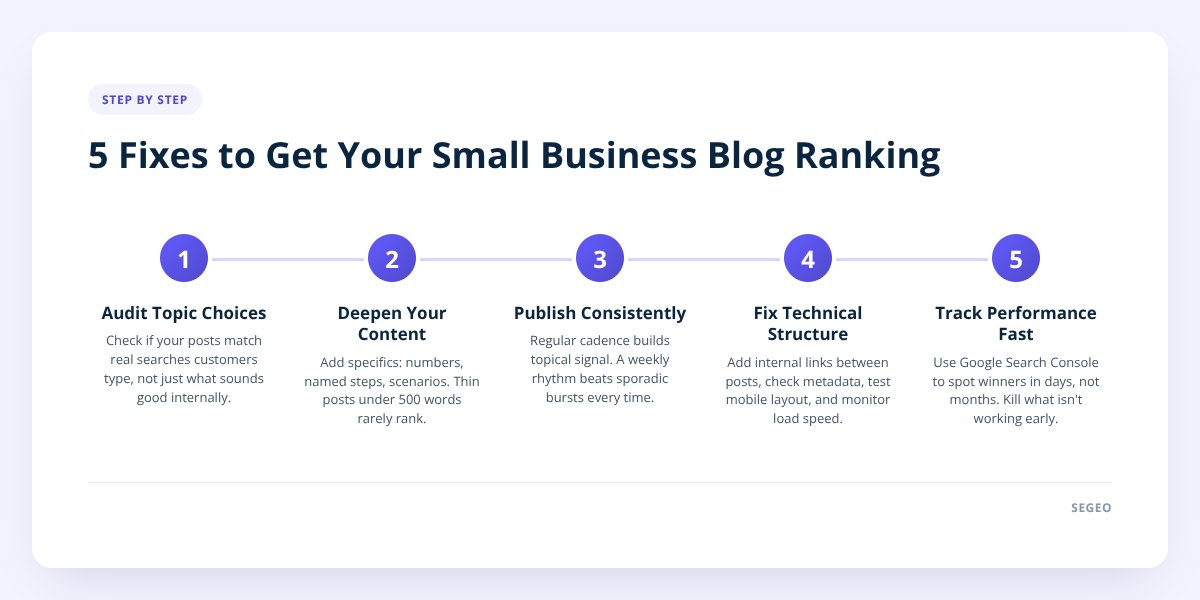
The Five Reasons Small Business Blogs Don't Rank
Here's the uncomfortable truth: most small business blogs aren't bad because the writing is bad. They're invisible because of five structural problems that have nothing to do with sentence quality.
- Keyword blindness — writing about what the business wants to say, not what people actually type into Google.
- Thin content — posts that skim a topic in 400 words with no specifics, so Google has no reason to trust them over a competitor's deeper post.
- Inconsistent publishing — a burst of five posts, then silence for two months.
- Broken structure — no internal links, missing metadata, slow load times, or a mobile layout that breaks.
- No tracking — publishing into the void and never checking what, if anything, happened.
Most owners find one of these and fix it, then wonder why rankings still don't move. That's because these five compound. A great post on the wrong topic still won't rank. A perfectly targeted topic in a 300-word post still won't rank. You usually need to fix at least three at once, which is exactly why this is a 30-day project, not a 30-minute one.
Failure #1: You're Writing About Topics Nobody Searches For
The fix starts with an honest audit, not more writing. Pull up your last 10 posts and ask, for each one: would a real customer type this exact phrase into Google? If the answer is no — if it's company news, a generic "5 tips" post, or something written because it felt like content should exist — that post was dead on arrival.
A rankable topic has two things: it matches a real search (something a customer would type, like "how much does a water heater repair cost" instead of "our thoughts on water heater maintenance"), and it matches something your business can speak to with specific authority. You don't need expensive software to find these. Google's autocomplete and the "People also ask" boxes on your own industry's search results are free and surprisingly accurate signals of what people actually search.
In week one, swap your next three scheduled posts for topics pulled straight from real searches in your industry. This alone, done with nothing else fixed, usually produces the first sign of movement — because you've stopped wasting effort on posts that could never rank regardless of quality.
Don't skip this: if a topic doesn't match a real search phrase, no amount of good writing will make Google rank it. Fix the topic before you touch the prose.
This is also where manual blogging quietly breaks down for a lot of owners — picking a rankable topic every single day, with no recycled calendar, is a research job in itself. Segeo pulls topics from live trend data and real local-intent keywords for your industry and city automatically, so you're never guessing or opening a keyword tool at 9pm.
Failure #2: Google Doesn't Trust What You've Written
Thin, generic content is the single biggest reason small business posts sit on page 4. A 350-word post that says "regular maintenance is important" without naming a single specific step, cost, or scenario gives Google — and a reader — nothing to hold onto.
Depth means specifics: real numbers, named steps, a worked example, an edge case most posts skip. Compare these two openings on the same topic:
- Thin: "Regular HVAC maintenance helps your system run efficiently and can save you money over time."
- Deep: "A dirty air filter can force your HVAC system to work up to 15% harder, according to the U.S. Department of Energy — and a filter swap takes about five minutes and costs under $20."
The second version is more citable, more useful, and far more likely to be the one Google — or ChatGPT, when someone asks it the same question — actually surfaces. This is the same logic AI answer engines use: they pull sentences that stand alone, carry a specific claim, and name a source. We go deeper on exactly what that pattern looks like in 3 Blog Post Examples That Rank in Google and Get Cited by AI.
The fix isn't "write longer." It's write with more substance per paragraph — add the number, the step, the named scenario — until the post earns its length.
Failure #3: You're Publishing Too Rarely or Too Erratically
Inconsistent publishing is a trust problem, not just a volume problem. A blog with a burst of posts in March and nothing until July signals to Google that this site isn't an active source — and it means you never build the compounding internal-link network that a steady blog creates.
How often should you blog? There's no single magic number, but the pattern that shows up again and again in SEO guidance is simple: consistent beats frequent. A site publishing one solid post every week, every week, for six months will usually outperform a site that published fifteen posts in one feverish month and then quit.
The timing matters for a second reason too: freshness. A post about a topic trending in your industry this week has a real shot at catching search interest while it's active. The same post published two months late is answering a question nobody's asking anymore. This is the exact gap daily, trend-driven publishing is built to close — which is the core of what Segeo does: it publishes a finished post to your site every day, picked from what your industry is actually discussing that week, not a recycled calendar from six months ago.
Failure #4: Your Blog's Technical Structure Is Working Against You
Even a great post can rank poorly if the plumbing underneath it is broken. Four structural issues quietly sink small business blogs most often:
| Issue | Why it matters | Quick check |
|---|---|---|
| No internal links | Google can't see how your posts relate to each other or to your service pages | Does this post link to at least one other post or page on your site? |
| Missing or duplicate metadata | Search engines use title tags and meta descriptions to understand and display your page | Does every post have a unique title tag and description? |
| Slow load speed | Google's own research ties slower load times to higher visitor drop-off | Run your blog URL through PageSpeed Insights |
| Broken mobile rendering | Most search traffic is mobile; a layout that breaks on phones gets a worse experience signal | Open your last post on your own phone |
Internal linking deserves special attention because it's the easiest to fix and the most commonly ignored. Every post should link to at least one other relevant post and one service page. We covered the full structural checklist — headings, schema, link patterns — in How to Structure Your Blog So Google and AI Actually Find It.
Failure #5: You're Publishing but Never Measuring Anything
Checking performance is the step most owners skip entirely, and it's the one that tells you which of the other four fixes actually worked. You don't need six months of waiting — Google Search Console will show you impressions (how often your post appeared in search results) within days of publishing.
Here's a simple 30-day check:
- Open Google Search Console and filter to pages published in the last month.
- Sort by impressions, not clicks — impressions show up first and tell you Google is at least considering the page.
- Flag any post with zero impressions after two weeks — that's almost always a topic or metadata problem, not a "give it more time" problem.
- Check which posts have impressions but zero clicks — that usually means the title or description isn't compelling, not that the content is wrong.
- Note which topics are gaining week over week — those are your signal to write more like them.
We built a full walkthrough of this exact process, with no guesswork, in How to Measure SEO Blog Performance Without Guesswork.
Your 30-Day Fix, Prioritized
You don't need to fix all five failures simultaneously. Work in this order, because each one makes the next one more effective.
Week 1 — Fix the topics. Audit your last 10 posts against real search phrases. Replace your next three scheduled topics with ones pulled from actual searches in your industry.
Week 2 — Fix the depth. Take your single best-performing post (by impressions) and rewrite the thinnest section with a real number, a named step, or a specific example. Apply the same pattern to new posts going forward.
Week 3 — Fix the structure. Add internal links between your last 10 posts. Check metadata on each. Run your blog through a mobile and speed check.
Week 4 — Fix the rhythm and start measuring. Commit to a publishing schedule you can actually sustain — weekly, minimum — and set up Search Console tracking if you haven't already.
The honest version of this plan is that it's a part-time job on top of running your business. That's the gap daily, automated publishing is built for: Segeo writes and publishes a finished post to your own site every day, in your business's voice (learned from your existing website), checked against your last 30 posts so topics don't repeat, and structured so Google and AI tools like ChatGPT and Perplexity can both find and cite it. Setup takes about five minutes, and you keep full control — edit, regenerate, or unpublish anything, or turn on review mode so nothing goes live without your approval.
If you want to see what the output actually looks like before committing to anything, check the pricing page — plans start from $89 a month with a 14-day money-back guarantee.
Ready to stop guessing and start publishing on a schedule Google actually rewards? Segeo handles the topic research, the writing, and the daily publishing — so the only thing left for you to do is check the results.
Checklist: Fix a Blog That Isn't Ranking
- Audit your last 10 posts against real search phrases, not company announcements.
- Swap your next three scheduled topics for ones pulled from actual Google searches in your industry.
- Rewrite your thinnest post section with a specific number, named step, or real example.
- Add internal links between your most recent posts and to at least one service page.
- Check metadata — unique title tag and description — on every live post.
- Run your blog's homepage through a mobile and page-speed check.
- Commit to a publishing schedule you can sustain for at least eight weeks straight.
- Set up Google Search Console and check impressions after two weeks, not six months.
