
Quick answer: SEO content converts when it does three things in order: ranks for a real search term, answers the question that term implies better than the other results, and gives the reader one clear next step. Most small-business posts only do the first one — they chase a keyword, pad it to 1,000 words, and stop. Add a direct answer up top, a concrete example, and a single call-to-action, and the same traffic starts turning into calls, emails, and sales.
Key takeaways
- A post can rank on page one and still convert at close to zero if it never tells the reader what to do next — rank and conversion are separate jobs, and most posts only do the first.
- Answering the reader's actual question in the first sentence of a section, not the fourth paragraph, is what both skimmers and AI answer engines reward.
- Every post needs exactly one call-to-action. Posts with three competing asks (newsletter, call us, download this) convert worse than posts with one.
- Publishing consistency matters more than any single post's polish — a thinner post today plus one tomorrow outperforms one perfect post a month, which is the whole logic behind Segeo's daily publishing model.
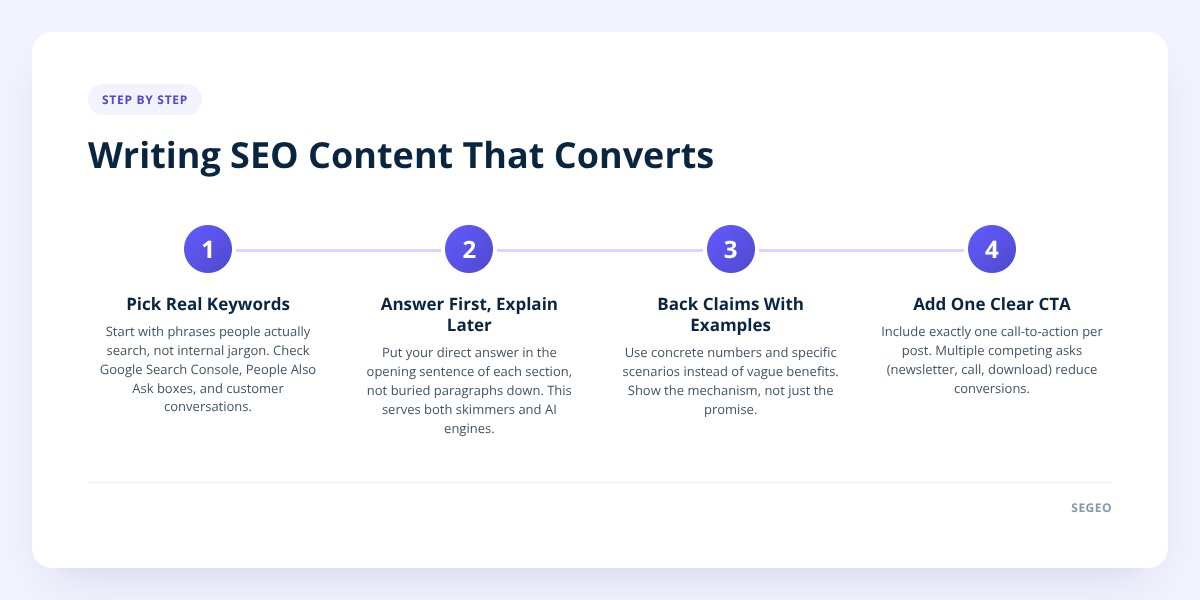
Why SEO Content Often Fails to Convert
Most small-business blog posts are written to satisfy a keyword, not a person. They open with throat-clearing, stuff in the target phrase four times, and end with a generic "contact us today" that could belong to any business in any industry.
That approach can still rank. Google's own guidance on helpful content rewards posts that match search intent, and a well-structured 1,200-word post about "how much does X cost" will often outrank a thin page with no real answer. But ranking only gets you the click. What happens after the click is a separate problem, and it's the one most owners never solve.
Here's the gap in plain terms: a reader lands on your post because they typed a question into Google. If your post reads like a brochure, they bounce. If it reads like you actually answered their question — with a number, a step, an example — they stick around long enough to notice you also run the business that could solve their problem. That second part is the part that's missing.
Don't skip this: a post that answers the question honestly, even when the honest answer is "it depends, here's why," converts better than a post that oversells. Readers can tell the difference, and so can AI tools summarizing your page.
Step 1: Rank for a Keyword a Real Person Would Type
Start with a phrase someone actually searches, not a phrase that sounds impressive internally. "Our commitment to quality service" ranks for nothing. "How much does a water heater replacement cost" ranks for something people type into Google at 11pm when their water heater just died.
A few ways to find real search phrases without expensive tools:
- Check your own Google Search Console for queries you already get impressions on but rank low for — that's low-hanging fruit.
- Type your topic into Google and read the "People also ask" box — those are documented real questions.
- Ask your front desk or sales team what customers ask on the phone every week. Those exact phrases are often search queries too.
- Look at review sites and forums in your industry for the language customers use, which is often different from the language you use internally.
This is also where topic selection usually breaks down for a solo owner. Picking a fresh, locally relevant, not-already-covered topic every single day is a research job on top of a writing job, which is why Segeo pulls topics from live trend and search data for the business's own industry rather than asking the owner to run keyword research every morning.
Step 2: Answer the Real Question in the First Sentence
Once you've picked the keyword, answer the question it implies immediately — not after three paragraphs of context. If your H2 is "How much does X cost," the first sentence under it should contain a number or a range, not a sentence about how pricing "varies depending on several factors."
This matters for two audiences at once:
- Human skimmers decide in seconds whether to keep reading. An answer up top keeps them on the page; a wind-up sends them back to Google.
- AI answer engines like ChatGPT, Perplexity, and Google's AI Overviews pull sentences that stand alone as complete answers. A buried answer is much harder for them to lift and cite than one sitting in the first sentence of a section.
We covered this pattern in detail in How to Write SEO Content That Google and AI Both Trust — the short version is that the structure that wins a featured snippet and the structure that wins an AI citation are the same structure. Answer first, explain second.
Step 3: Prove It With a Specific, Concrete Example
A claim without a number is an opinion. A claim with a number is evidence. Compare these two sentences:
- "Regular blogging helps your SEO over time."
- "A business publishing weekly for six months typically has far more indexed pages competing for search terms than one that posted twice all year — and each indexed page is a separate shot at ranking."
The second sentence gives the reader something to picture. It doesn't need to cite a customer result you don't have — it just needs to be concrete about the mechanism, not vague about the benefit.
Worked example: imagine a plumbing company writes a post titled "Why Is My Water Bill So High All of a Sudden?" A padded version spends two paragraphs on "water bills can be confusing" before mentioning leaks. A converting version says in sentence one: "A sudden spike usually means a running toilet, a hidden pipe leak, or an irrigation line left on — here's how to check each in under ten minutes." Then it walks through the three checks. Then it says: if none of those checks finds the problem, here's the number to call for a leak detection visit. That's proof (the specific checks), followed by one clear next step.
Step 4: Give the Reader Exactly One Next Step
A post that ends with three competing asks — subscribe, call, follow us on Instagram — usually gets none of them. Pick the single action that matches where the reader is in their decision, and ask for only that one.
| Reader's likely stage | Best single CTA | Why it fits |
|---|---|---|
| Just researching, early question | Read a related post or guide | They're not ready to buy, give them more value instead |
| Comparing whether to DIY or hire | A specific, low-commitment action (get a free estimate, download a checklist) | Low friction matches low urgency |
| Ready to act, has the problem now | A direct contact prompt (call, book, email) | They need a clear next step, not more content |
Match the CTA to the post's topic specifically. A post titled "how much does X cost" should end with something like "get a free quote for your specific situation," not a generic "learn more about us." The CTA should sound like it was written for this exact post, because it was.
Common Conversion Mistakes in Small-Business Posts
Most of the posts that rank but don't convert share the same handful of problems, and all of them are fixable without rewriting the whole post.
- The keyword is in the title but never answered in the body. Fix: read your own H2s out loud and check whether the sentence right under each one actually answers it.
- The post is generic enough to belong to any competitor. Fix: name your actual city, your actual service, your actual hours or process — specifics are what make a post yours and what local search and AI tools look for.
- Three CTAs fight for attention at the bottom. Fix: pick one and delete the others.
- The example is abstract instead of concrete. Fix: replace "many customers find" with one specific, plausible scenario and real numbers.
- The post was written once and never followed up. A single great post ranks for one question. A business that publishes consistently builds coverage across dozens of the questions its customers actually ask, which is the core idea behind how often should I blog — daily output compounds in a way an occasional post can't.
This last one is where most owners quietly give up, not because the strategy is wrong but because writing a genuinely useful, non-generic post every day is a real time cost. That's the specific gap Segeo's daily publishing closes: a finished, on-topic post goes live on the business's own site every day, in that business's own voice pulled from its existing website, with a real service and city named in the post — not a draft waiting in a queue for someone to find time to edit.
Quick Checklist: Audit Your Last Five Posts
Pull up your five most recent blog posts and run each one through this before you write a sixth.
- Check whether the H1 or H2 matches a phrase a real customer would type into Google.
- Confirm the first sentence under each H2 actually answers the question, not three paragraphs later.
- Find one concrete number, example, or step in the post — if there isn't one, add it.
- Count the calls-to-action at the end. If there's more than one, cut it down to one.
- Confirm your city and a specific service name appear somewhere in the post, not just "our team" and "our services."
- Check the post against your last 30 posts for topic overlap — repeating the same angle wastes a publishing slot.
- Read the whole post out loud. If you'd skip a paragraph yourself, a reader will too.
What to Do Next
Run that checklist against one existing post this week and fix what it flags — that alone usually moves a post from "ranks but does nothing" to "ranks and gets a response." Then decide whether you want to keep doing that audit by hand every week, or let it run on autopilot.
If the research, the daily writing, and the consistency are the part that keeps stalling, that's exactly what Segeo is built to handle — a finished post published to your own site every day, topic picked from live trend data, written in your brand voice, with review mode if you want to approve posts before they go live. Plans start from $89 a month; see current pricing at segeo.net/pricing.
Checklist: Write a Blog Post That Ranks and Converts
- Pick a keyword phrase a real customer would type, using Search Console data or "People also ask" results.
- Write the H2 as the actual question, then answer it in the very next sentence.
- Add one concrete example, number, or step before moving to the next section.
- Name your actual city and a specific service you offer somewhere in the post.
- Choose one call-to-action that matches the reader's likely stage in their decision.
- Delete any second or third competing CTA at the end of the post.
- Check the new topic against your last several posts to avoid repeating an angle.
- Read the finished post out loud and cut any paragraph you'd personally skip.
Related articles
- How to Write SEO Content That Google and AI Both Trust
- How Often Should I Blog? Daily Beats Weekly for SEO
- 3 Blog Post Examples That Rank in Google and Get Cited by AI
