
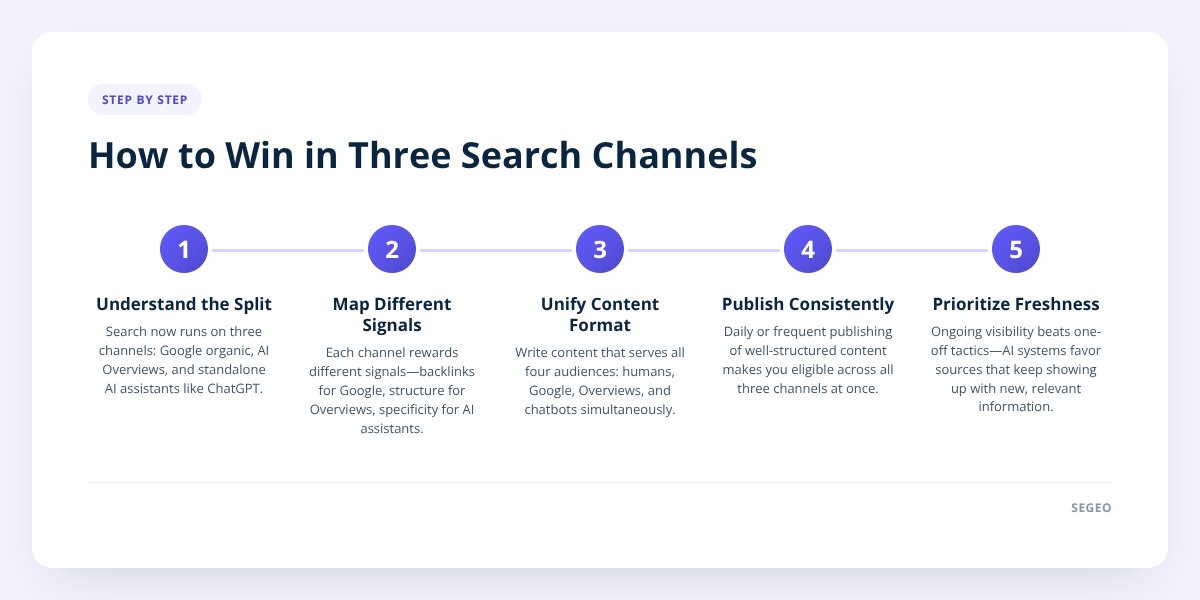
Quick answer: Search is no longer one thing you optimize for — it's three. Google's classic organic results, Google's AI Overviews, and standalone AI assistants like ChatGPT and Perplexity each pull from different signals and show different businesses, so ranking well in one doesn't mean you exist in the others. The fix isn't three separate strategies; it's publishing consistent, well-structured content often enough that all three channels have fresh material to pull from.
Key takeaways
- AI Overviews and standalone assistants like ChatGPT often cite different sources than Google's organic results do, even for the same query — a retailer can appear in one and be invisible in the other.
- No one, including Segeo, can guarantee a ranking or an AI citation — the variable you control is whether you're publishing enough structured, specific content to be eligible at all.
- A single daily blog post, written to answer real questions in plain language, can feed all three channels at once instead of requiring separate content for each.
- Review consistency matters more than any single tactic: AI systems and Google both favor sources that keep showing up with new, relevant information.
What are the three search channels small businesses compete in now?
They are Google's traditional organic results, Google's AI Overviews, and standalone AI assistants such as ChatGPT, Perplexity, and Gemini — and each one works differently under the hood. Traditional organic search still relies heavily on backlinks, keyword relevance, and site authority built over time. It's the search world most small business owners grew up optimizing for, and it still sends real traffic.
AI Overviews is Google's summary box that appears above the regular results for many searches, built by pulling and condensing information from multiple sources. It draws on Google's own index but weighs things differently than classic ranking does — a page can rank on page one and still get skipped by the Overview, or vice versa.
Standalone AI assistants are a separate animal entirely. ChatGPT, Perplexity, and similar tools aren't ranking a list of links — they're generating an answer and deciding, in real time, which sources are specific and trustworthy enough to cite. They don't share Google's index or its ranking logic, which means a business invisible on Google can still get mentioned by ChatGPT, and the reverse happens just as often.
This is why "SEO" as a single word undersells what's actually required. Optimizing for one channel used to be enough because there was only one channel that mattered. Now a business needs content structured so a human can read it, Google can rank it, AI Overviews can summarize it, and a chatbot can quote it — four different audiences reading the same page.
Why doesn't ranking well in one channel carry over to the others?
Because each channel pulls from different signals, so a business can be strong in one and completely absent from another — and that gap is common, not rare. A Shopify store might show up reliably in ChatGPT answers about "best running shoe brands for wide feet" because the product pages are specific and well-described, while that same store never appears in Google's AI Overview for a near-identical search, because the Overview is pulling from a different mix of sources it considers authoritative for that query.
The reverse happens too. A business can rank on page one of Google organic for years on the strength of backlinks and domain age, and still get left out of an AI Overview or a ChatGPT answer because the actual page content is thin — a product listing with no real explanation, no comparison, no answer to the question someone would actually ask.
A few patterns show up often enough to matter:
| Channel | What it tends to reward | What gets left out |
|---|---|---|
| Google organic | Backlinks, domain history, page speed, keyword match | Pages that rank but don't directly answer the query |
| AI Overviews | Clear, well-structured answers near the top of a page | Pages buried in fluff before the actual answer |
| ChatGPT / Perplexity | Specific, self-contained claims with named sources or numbers | Vague "we're the best" copy with nothing to quote |
The practical takeaway: a business can't check one box and assume the others follow. Each channel has to be given something it can actually use — and that's a content problem, not a technical one.
What actually closes the gap between channels — daily publishing or one-off tactics?
Structural consistency closes the gap — publishing often enough, in a format all three channels can parse, beats any single trick aimed at one channel. A business that writes one blog post a quarter, optimized hard for Google keywords, is solving for exactly one channel and hoping the others notice. A business that publishes something genuinely useful every day, structured so the answer appears early and claims are specific, gives Google, AI Overviews, and chatbots the same raw material at the same time.
Don't skip this: No tool, including Segeo, can promise a ranking or an AI citation — anyone who says otherwise is selling something. What consistent, well-structured publishing does is make a business eligible to be picked up across all three channels, which is the only part anyone actually controls.
One-off tactics tend to fail for a specific, predictable reason: they treat visibility as a single event instead of an ongoing pattern. A business might hire someone to write five "SEO-optimized" posts, publish them over a month, then go quiet for a year. Google's organic rankings might hold for a while on the strength of those posts. But AI Overviews and chatbots favor freshness and depth of coverage — a thin, stale site gives them little reason to keep citing it, and a business that goes quiet for months stops looking like an active, trustworthy source.
This is the structural problem daily blogging actually solves. It's not that one post a day is magically better written than one post a month — it's that volume and consistency build the kind of topic coverage that search systems increasingly treat as a trust signal. We covered the mechanics of this in why publishing daily doesn't guarantee AI search visibility — daily publishing is necessary, not sufficient, and the structure of each post still has to do its job.
Manual blogging can get a business most of the way there, but it breaks down at the point of sustained frequency. Writing one genuinely good, well-researched post a day, every day, for months, is a full-time job most small business owners don't have time for — which is exactly the gap automated publishing tools exist to close.
How does fragmented search actually show up in a business's traffic over a month?
It shows up as traffic and mentions coming from sources that didn't exist five years ago, arriving at different times and for different reasons than classic Google clicks. A business that starts publishing consistently — whether by hand or through an automated tool like Segeo, which writes and auto-publishes a finished post to a business's own site every day — typically sees three overlapping shifts play out over roughly 30 days:
- Week 1–2: New pages get indexed by Google and start appearing for long-tail, low-competition searches — specific questions rather than broad keywords.
- Week 2–3: Pages that directly answer a question in the first sentence start getting pulled into AI Overviews for related searches, especially if the page names specific numbers, steps, or local details.
- Week 3–4: Chatbots like ChatGPT and Perplexity, which crawl and index content on their own schedules, begin surfacing the newer pages in answers to users asking for recommendations or comparisons.
- Ongoing: None of this is linear or guaranteed — a page can get cited one week and dropped the next as these systems update their own sources, which is normal and not a sign something is broken.
The common thread across all three is specificity. A page titled "Best Plumbers" with generic copy gives none of these systems anything to grab onto. A page that says "Here's how to tell if a running toilet is wasting water, and roughly what it costs to fix" gives Google a keyword match, gives AI Overviews a clear answer to summarize, and gives a chatbot a concrete, quotable claim.
This is also why topic selection matters as much as writing quality. A blog that recycles the same five ideas in different words stalls out — there's nothing new for any of the three channels to pick up. Segeo's approach checks every new topic against the business's last 30 posts specifically so the blog keeps building coverage instead of circling back, and pulls topics from live trend data rather than a generic content calendar, so the posts match what people are actually asking that week.
Does this mean small businesses need a completely different kind of content than before?
Not a different kind of content — the same qualities that always made content good now matter for three audiences instead of one. Clear writing, specific answers, and real expertise were always what separated a useful blog post from filler. What's changed is that those qualities now get read by a Google crawler, an AI Overview summarizer, and a chatbot's citation logic, in addition to a human — so sloppy, vague, keyword-stuffed writing fails in more places than it used to.
A few things to check on any page meant to perform across all three channels:
- Answer the core question in the first one or two sentences, not after three paragraphs of setup.
- State specific facts — numbers, steps, named sources — rather than vague claims like "many experts agree."
- Break up long paragraphs so both readers and AI summarizers can find the actual answer fast.
- Name the business, the service, and (if relevant) the city directly in the text, not just in metadata.
- Keep publishing on a schedule rather than in occasional bursts.
We go deeper on the structural side — how to format a page so an AI Overview can actually lift from it — in how to structure a blog post for AI Overviews optimization.
The honest version of all this: no one can hand a small business owner a guarantee that they'll show up in a ChatGPT answer or an AI Overview next month. What's controllable is whether the business is publishing specific, useful, well-structured content often enough to be in the running at all — and for most owners, that's the part that quietly stops happening after the first few posts.
If keeping that pace up by hand isn't realistic, Segeo runs the whole loop — daily topic selection from trend data, writing in the business's own voice, and publishing straight to the site — for a flat rate starting at $89 a month, detailed on the pricing page. Setup takes about five minutes, and review mode means nothing goes live without approval if that's how an owner wants to run it. Reach out through Segeo to see how it connects to your site.
Checklist: Making your content work across all three search channels
- Write the direct answer to the reader's question in the first sentence of each section.
- Replace vague claims ("top-rated," "industry-leading") with specific numbers, steps, or named facts.
- Name your business, your city, and a real service you offer somewhere in the post.
- Publish on a consistent schedule rather than in occasional bursts.
- Check new topics against your last month of posts so you're building coverage, not repeating it.
- Break long paragraphs into 2–4 sentence chunks so both readers and AI tools can parse them.
- Set up review mode or a similar check if you want to approve content before it goes live.
- Revisit older posts occasionally to confirm facts and figures are still current.
