
Quick answer: Pick topics by cross-checking three signals: what your customers actually type into Google (from Search Console, autocomplete, or your own support inbox), whether AI assistants are already answering that question well, and where you can say something clearer or more specific than what's out there. A topic that scores on all three — real demand, a thin or missing AI answer, and a gap you can fill — is far more likely to rank and get cited than anything picked from a generic content calendar.
Key takeaways
- Most small business blogs fail not because the writing is bad, but because the topic was guessed instead of researched — guessing rarely satisfies either Google's ranking signals or an AI model's citation criteria.
- Google Search Console's "Queries" report shows the exact phrases people already use to find your site, including ones you rank for on page two that a dedicated post could push higher.
- Testing whether ChatGPT, Perplexity, or Google's AI Overviews already answer a question well — before you write about it — tells you whether you're filling a gap or adding noise.
- A topic with decent search volume but a vague, generic, or outdated AI answer is a better target than a high-volume topic every competitor has already covered in depth.
Why Most Blog Topics Rank Nowhere and Get Cited by No One
A blog post written from a "content ideas" list — the generic kind with titles like "5 Tips for Spring Cleaning" or "Why Customer Service Matters" — usually fails twice. It doesn't rank in Google because a hundred other businesses wrote the identical post, and it doesn't get cited by ChatGPT or Perplexity because there's nothing in it those tools can't already say on their own.
The two failures have the same root cause: the topic wasn't chosen based on evidence. It was chosen based on what sounded like a reasonable thing to write about.
Google and AI assistants are actually looking for different versions of the same thing. Google wants a page that clearly answers a query real people type in, backed by signals that it's trustworthy and well-structured. AI models want a page that states a fact or answer plainly enough to lift and attribute — specific, self-contained, and ideally saying something the model doesn't already know from its training data.
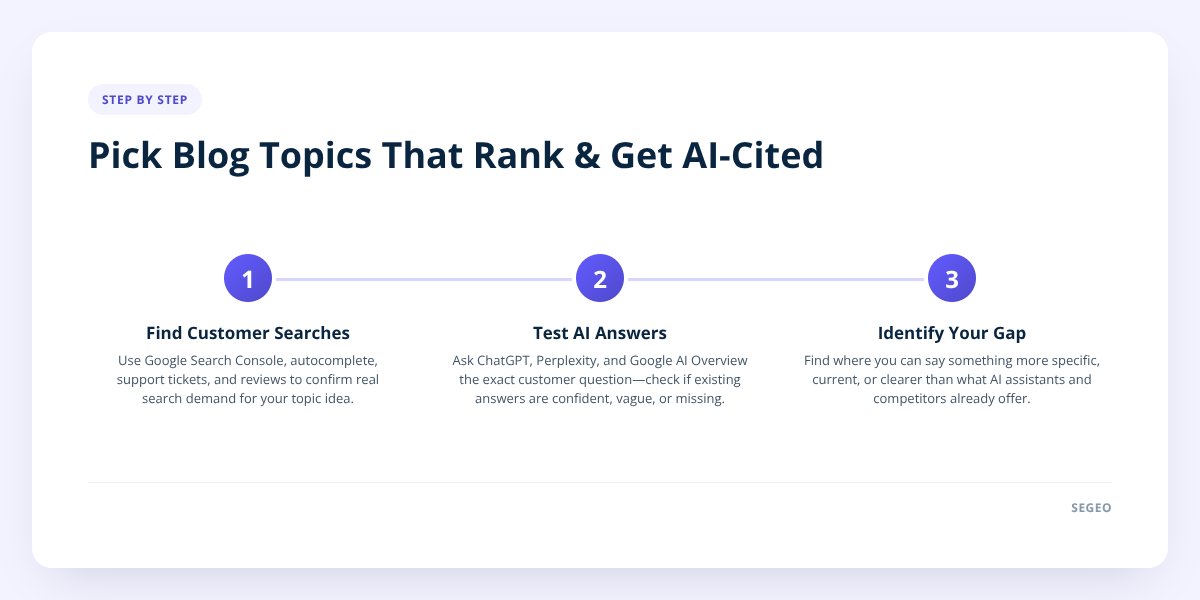
That means the topics that win in both places sit at the intersection of three questions:
- Do people actually search for this?
- Is the current AI answer to this thin, outdated, or missing?
- Can you say something more specific or more current than what's already out there?
The rest of this guide walks through how to answer each one without hiring an agency or spending a weekend in spreadsheets. We've covered the writing side of this separately in how to write SEO content that ranks and gets cited by AI — this post is about picking the right topic before you write a word.
Step 1: Find What Your Customers Are Actually Searching For
The fastest, free way to do this is Google Search Console, which shows the exact queries that already bring people to your site — including the ones where you rank on page two or three and a dedicated post could push you higher. Go to the "Performance" report, sort by impressions, and look for queries with decent impressions but low click-through. Those are topics Google already thinks you're somewhat relevant for; you just haven't answered them well enough yet.
Search Console isn't the only free source. Combine it with:
- Google autocomplete and "People also ask." Type your topic into Google and note what it suggests — these are real queries Google has seen at volume.
- Your own support tickets and sales emails. If three customers this month asked "do you offer financing" or "how long does installation take," that's a blog topic with proven demand, not a guess.
- Review site questions. Yelp, Google Business Profile Q&A, and industry forums often surface the exact phrasing customers use, which is useful for matching search intent.
- Competitor comment sections and reviews. Complaints and confused questions under a competitor's post reveal what that post didn't answer clearly.
We go deeper on the Search Console method specifically in Search Console blog topic ideas: a step-by-step guide, including exactly which columns to sort by.
Don't skip this: a topic with zero evidence of real search demand — no Search Console impressions, no customer questions, no autocomplete hits — is a guess no matter how well you write it. Confirm demand before you invest the hour it takes to write a good post.
Step 2: Check Whether AI Assistants Already Answer It Well
This is the step almost every small business skips, and it's the one that determines whether you'll ever get cited. Before writing, ask ChatGPT, Perplexity, and Google directly (to see the AI Overview) the exact question your customers ask, and read what comes back.
There are three outcomes, and each one tells you what to do next:
| What you see | What it means | What to do |
|---|---|---|
| A confident, detailed, well-sourced answer | The gap is closed — hard to add new value | Skip it, or find a narrower angle it misses |
| A vague, generic, or outdated answer | Real opportunity — the model is guessing or using stale data | Write it, and be specific |
| No clear answer, or the model hedges | Open territory | Write it — you could be the first clear source |
Why does this matter if Google already ranks you? Because ranking in Google and getting cited in an AI answer are no longer the same prize. Search traffic is increasingly splitting across three channels — traditional search results, AI Overviews, and standalone AI assistants — and a topic can win in one and lose in the others. We mapped out exactly how that split happened in why search split into three channels and how to win.
A practical example: if you run a pet grooming business and ask ChatGPT "how often should I bathe my dog," you'll likely get a solid, well-covered generic answer — that topic is saturated. But ask "how often should I bathe a double-coated breed in a humid climate" and you're more likely to get a hedge or a generic non-answer. That's your topic, not the broad one.
Step 3: Find the Citation Sweet Spot — Where You Can Be First or Clearest
The sweet spot is a topic with proven search demand (Step 1) and a weak or missing AI answer (Step 2) — that combination is rare, and it's exactly where small businesses have an advantage over big brands. Large companies chase high-volume keywords with generic content. Specific, local, or niche questions get ignored because they don't look worth the effort at scale. That's precisely why they're worth your effort.
Look for three patterns when you're choosing between topics that pass Step 1 and Step 2:
- Specificity beats breadth. "How much does a kitchen remodel cost" is covered everywhere. "How much does a kitchen remodel cost in an older home with knob-and-tube wiring" is a gap.
- Recency beats evergreen when the facts actually changed. If a rule, price, or regulation in your industry changed this year, AI models trained on older data may still give the old answer — a dated, accurate post is a strong citation candidate.
- First-person expertise beats aggregation. A plumber explaining exactly how they diagnose a specific noise, with the actual steps they take, is harder for a model to find elsewhere than a listicle of "5 reasons your pipes make noise."
One mistake to watch for: picking a topic that's narrow but has no search demand at all. Narrow and ignored isn't a gap, it's just irrelevant. The sweet spot needs both — people asking, and nobody answering clearly.
Step 4: Publish, Measure, and Double Down on What Actually Works
Picking a good topic is step one of a longer loop — publish it, check whether it ranks or gets cited within a few weeks, then use what you learn to pick the next one. A single post is a hypothesis, not a result.
What to check after a post has had time to be indexed and crawled, typically two to four weeks:
- Search Console impressions and position for the target query — did it move at all, even to page two?
- Direct testing in ChatGPT and Perplexity — ask the same question again and see if your business or page shows up in the answer or sources.
- Click-through rate on the post once it has impressions — a low CTR with decent impressions usually means the title or meta description needs work, not the topic.
We wrote a full walkthrough of the measurement side, including what tools actually show you AI citations (most standard analytics don't), in how to measure if your blog shows up in AI search.
The businesses that win this long-term aren't the ones that nail one topic — they're the ones that publish often enough to run this loop dozens of times a year and keep what works. That's a lot of manual research to repeat every week by hand, which is the exact problem Segeo is built around: it pulls topics from live trend and local-intent data for your specific industry, checks each new idea against your last 30 posts so you're not circling the same five topics, and publishes a finished post to your site daily — structured so ChatGPT, Gemini, and Perplexity can cite it, not just so Google can rank it. You still get a say: review mode holds every post for your approval before it goes live if you want that control.
If you'd rather see the mechanics of how a post gets built this way before it's published, the docs walk through the connection and publishing flow, and pricing lays out the plan — one tier, from $89 a month, covering the research, writing, images, and publishing in one.
Checklist: Picking a Blog Topic That Ranks and Gets Cited
- Pull your Search Console "Queries" report and sort by impressions to find proven demand.
- Note the exact questions from your last month of support tickets and sales emails.
- Check Google autocomplete and "People also ask" for your top three topic candidates.
- Ask ChatGPT, Perplexity, and Google directly the exact question you're considering writing about.
- Mark each candidate as saturated, weak, or open based on how those AI answers read.
- Choose the topic where real demand overlaps with a weak or missing AI answer.
- Write the post with a specific, current, first-hand answer — not a generic overview.
- Re-check rankings and AI answers two to four weeks after publishing.
- Repeat the loop weekly, keeping a running list of what worked and what didn't.
