
Quick answer: AI Overviews skip most Shopify stores because their default blog structure creates orphaned posts, thin category pages, and no clear topic hierarchy — the exact signals large language models use to decide what's trustworthy enough to cite. Fixing this doesn't require a new theme or a replatform. It requires linking related posts together, building real topic clusters, and publishing consistently enough that the structure has something to hold onto.
Key takeaways
- Shopify's default blog template has no built-in category or tag hierarchy, which makes it hard for AI crawlers to tell what a post is "about" in relation to the rest of the site.
- Posts with zero internal links pointing to them — often called orphaned pages — are far less likely to be pulled into AI Overviews, according to widely documented SEO crawling principles.
- Topic clusters (a hub page linked to several related posts) give AI models a clear signal of expertise that a single standalone post can't.
- Publishing daily, even short posts, compounds internal linking opportunities faster than weekly or monthly posting — every new post is a chance to link back to older ones.
Why do some Shopify stores show up in AI Overviews and others don't?
The stores that show up have content that's structurally connected — the ones that don't have content that's just sitting there. Google's AI Overviews and tools like ChatGPT and Perplexity don't read a website the way a person does, scrolling and inferring context. They rely on crawlable signals: internal links, header structure, schema markup, and how tightly related pages cluster around a topic.
A Shopify store might have thirty blog posts and forty product pages, all decent quality, and still get nothing. That's usually not a writing problem. It's a wiring problem.
Three structural gaps show up over and over on Shopify sites specifically:
- Thin category pages. Shopify's collection pages are built for browsing, not for explaining. A collection page titled "Candles" with twelve product thumbnails and no descriptive text gives an AI model nothing to summarize or cite.
- Metadata that's an afterthought. Many Shopify themes auto-generate title tags and meta descriptions from the product name alone, with no room for the context that answers a real question.
- A blog that lives in its own corner. The default Shopify blog template sits at a separate URL path, often with no link from the homepage, no link from product pages, and no link between the posts themselves.
Any one of these alone is survivable. Together, they tell an AI crawler this site doesn't have a coherent point of view on anything — just scattered pages.
What structural problems make AI models skip a Shopify blog?
Three problems show up most often, and they compound each other: orphaned posts, no topic clustering, and weak internal linking. We covered the mechanics of AI-readable structure in more depth in Why Your Blog Posts Aren't Showing Up in AI Overviews, but here's how it plays out specifically on Shopify.
Orphaned posts. An orphaned post is a page with no internal links pointing to it from anywhere else on the site — not the homepage, not a category page, not another blog post. Shopify's blog list page technically links to every post once, but that's the only link most posts ever get. If nothing else on the site references it, an AI crawler has almost no way to judge whether that post matters or connects to anything the business is known for.
No topic clustering. A topic cluster is a group of pages that all link to and from a central hub page about one subject — think one main guide plus five related posts, all cross-linked. Most Shopify blogs are the opposite: thirty unrelated one-off posts about candle scent trends, shipping delays, a founder's story, and a holiday gift guide, none linked to each other. AI models look for clusters because a cluster signals depth. A pile of unrelated posts signals none.
Weak internal linking. Even when a Shopify blog has related posts, most themes don't prompt the writer to link them. There's no "related posts" module active by default in many themes, and most store owners never think to manually cross-link a new post to three older ones on the same topic.
Don't skip this: if a blog post has no internal links pointing to it and links to nothing else on your site, treat it as invisible to AI crawlers — not just underperforming, invisible. Structure fixes this faster than better writing does.
Does Shopify's blog architecture actually work against AI visibility?
Yes, in a specific way: Shopify was built to sell products, and its blog is a bolted-on feature, not a content engine. That's not a knock on Shopify as a commerce platform — it's excellent at checkout, inventory, and product pages. But the blog module was designed for occasional announcements, not for building the kind of interlinked content library that AI models reward.
Here's where that shows up:
| Shopify default behavior | Why it hurts AI visibility |
|---|---|
Blog posts live at a separate /blogs/news path |
Disconnected from product and collection pages, so topical relevance doesn't transfer |
| No native tag-based hub pages | Nothing to serve as the "cluster hub" AI models look for |
| No automatic related-posts linking | Every post starts as an orphan unless someone manually links it |
| Meta descriptions often auto-filled | Missing the specific, answer-first phrasing AI Overviews tend to pull from |
| Infrequent posting (most stores post monthly or less) | Fewer opportunities to build the internal link web that ties posts together |
This is exactly why automation helps here — not because a human couldn't fix each of these one at a time, but because doing it manually, post by post, for months in a row is where most store owners quit. A system that publishes daily and links new posts back to older, related ones does the linking work as a byproduct of just showing up consistently. We go deeper on the daily-versus-occasional question in How Often Should I Blog? Daily Beats Weekly for SEO.
How do you actually fix this without rebuilding your store?
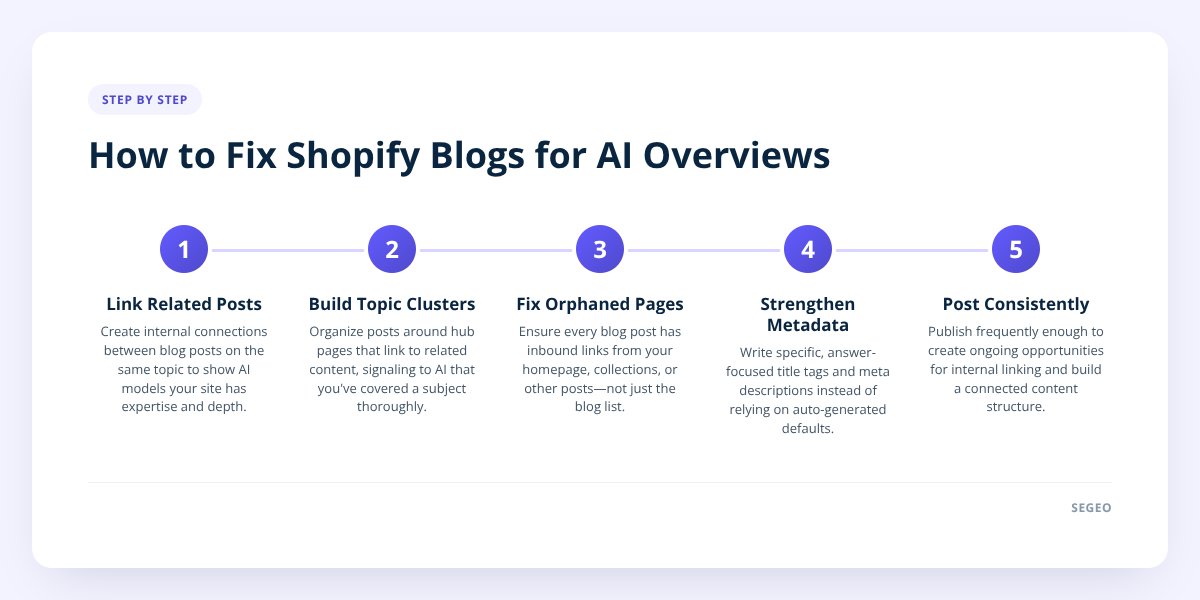
You fix it by clustering what you already have, adding semantic links between related posts, and increasing how often you publish — not by switching platforms or redesigning your theme. Three concrete moves, in order of effort:
- Build one hub page per core topic. If you sell skincare, a hub page like "Sensitive Skin Guide" can link out to five existing posts on ingredients, patch testing, product picks, and routine order. This costs nothing but your time and turns five orphaned posts into one cluster.
- Add semantic links between posts, not just navigation links. A semantic link is a link placed inside the body text where it's contextually relevant — "if your skin reacts to fragrance, start with our patch-test guide" — rather than a generic "related posts" widget at the bottom. AI models weigh in-context links more heavily because they signal genuine topical connection, not just site navigation.
- Publish often enough that clustering becomes automatic. A store publishing one post a month has to manually go back and link four times a year. A store publishing daily has a new linking opportunity every single day — every post becomes a chance to point back to two or three related ones, and the cluster builds itself over weeks instead of requiring a big cleanup project.
- Fix category page copy. Add two or three paragraphs of real explanatory text to your top collection pages — what the products are for, who they're for, how to choose between them. This gives AI crawlers something to summarize besides a grid of thumbnails.
- Check your title tags and meta descriptions manually. Don't rely on Shopify's auto-generated versions; write ones that answer a specific question in the first sentence.
None of this requires touching your checkout flow, your theme code, or your product data. It's almost entirely a content and linking exercise layered on top of the store you already have.
What does an AI-optimized Shopify blog structure actually look like?
Picture two versions of the same candle store's blog, six months apart.
Before: Twelve posts published over the year, each a few hundred words, topics all over the place — "Our Fall Scent Drop," "Why We Started This Company," "5 Gift Ideas Under $30," "Candle Care Tips." No post links to another. The collection page for "Fall Candles" has a title, six product photos, and no text. Search Console shows the blog gets almost no impressions, and the store has never appeared in an AI Overview for any candle-related query.
After: The same store restructures around three hubs — Scent Guide, Candle Care, and Gifting — and adds two new posts a week that each slot into one of those hubs and link to at least two existing posts in the same cluster. The "Fall Candles" collection page gets three paragraphs explaining scent notes and burn time. Within a few months, the Candle Care hub has eight interlinked posts, and one of them — "How Long Should a Candle Burn Before You Blow It Out" — starts appearing in AI Overviews for that exact question, because it answers it directly in the first line and sits inside a cluster of related, cross-linked pages.
Nothing about the products changed. The structure did. That's the pattern worth noticing: AI visibility rewards a site that behaves like it has expertise on a topic, demonstrated through linked, clustered, consistently updated content — not a site that simply has more words on it.
This is the exact gap Segeo is built to close for small e-commerce stores — a daily post that's automatically linked into the right topic cluster, with topics pulled from what shoppers in your category are actually searching that week, so the structural work happens as a side effect of publishing instead of a separate project you have to find time for.
If your Shopify blog has posts scattered with no connective tissue between them, Segeo can take over the daily writing and structuring so every new post reinforces the ones before it. Reach out to see how a hosted blog with automatic clustering would slot into your current store.
Checklist: Fixing Shopify blog structure for AI visibility
- Audit your existing posts and group them into three to five topic buckets.
- Build one hub page per bucket, linking out to every related post you already have.
- Add two to three in-body semantic links to each existing post, pointing to related posts in its cluster.
- Rewrite the text on your top three collection pages to include real explanatory paragraphs.
- Check title tags and meta descriptions on your highest-traffic posts and rewrite any auto-generated ones.
- Set a consistent publishing cadence and add new posts to their matching cluster as you go.
- Re-check Google Search Console monthly to see which posts start gaining impressions after the cluster forms.
