
Quick answer: The right provider for llm seo publishes to your own website consistently, picks topics from real search and trend data instead of a generic calendar, writes in a voice that actually sounds like your business, and shows you some form of tracking for how often you show up in Google and in AI answers like ChatGPT or Perplexity. Avoid anyone who guarantees rankings, won't let you see or edit posts before they go live, or can't explain in plain language what makes their content different from a content mill. Price matters less than whether the work is consistent — a $600-a-month agency that posts twice a month will likely lose to a $89-a-month tool that posts every day.
Key takeaways
- No provider can guarantee a ranking or an AI citation — Google and AI assistants don't sell that outcome to anyone, and any pitch that promises it is a red flag.
- Consistency beats volume in a single burst: a steady publishing schedule gives Google's crawlers and AI models more chances to find and trust your site over time.
- Ask any provider how topics are chosen — if the answer is "a content calendar we reuse for every client," that's generic SEO, not content built for your business.
- Look for review mode or an edit option before anything publishes under your business's name — you should never be surprised by what's live on your own site.
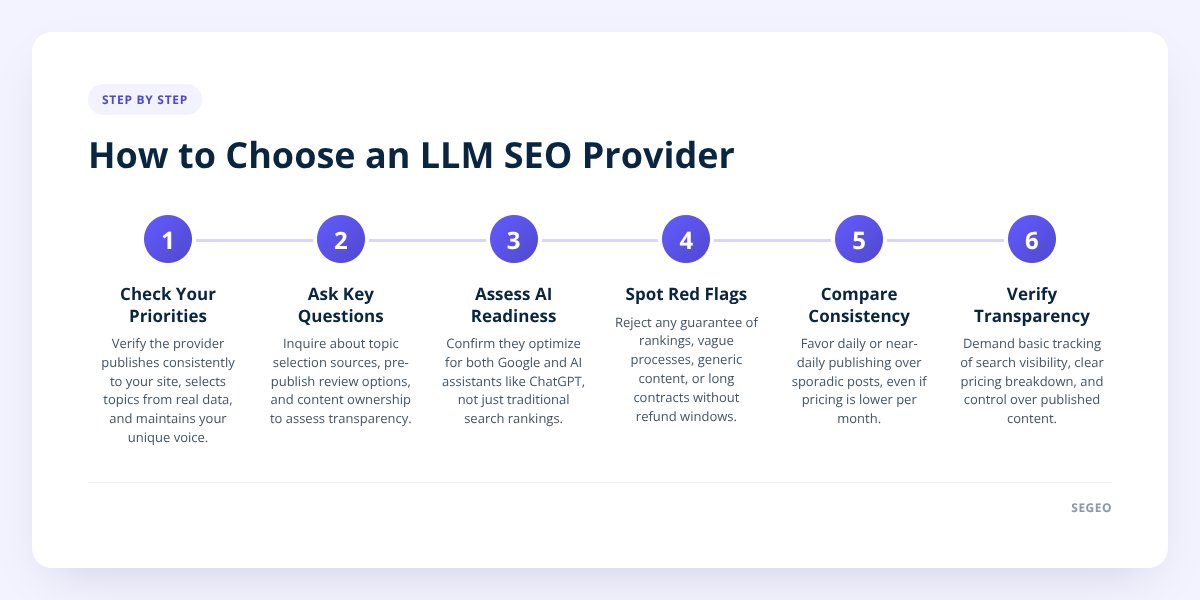
What should I look for in an LLM SEO provider?
Look for a provider that treats your website as the main asset, not an afterthought to social media. LLM SEO means optimizing your content so large language models — the systems behind ChatGPT, Perplexity, and Google's AI Overviews — can find, understand, and cite your business when someone asks a relevant question. That's a different skill than old-school keyword stuffing, and it requires different things from a provider.
Here's what actually matters:
- Daily or near-daily publishing, not a once-a-month blog post that sits stale for weeks.
- Topic selection tied to real data — what people are actually searching for in your industry, not a recycled list of generic headlines.
- Your own voice, pulled from your existing website or materials, so posts don't read like they were written for a different business and pasted in.
- Structure built for citation — clear headings, direct answers near the top, and facts an AI model can lift cleanly, not walls of marketing copy.
- Visibility into what's working, even if it's basic — some signal of whether your content is showing up in search or AI answers.
- Control over what publishes — the ability to review, edit, or pull a post before or after it goes live.
A provider that checks most of these boxes is worth a real look. One that checks none of them is just a content mill with a modern label.
What questions should I ask before signing up?
Ask how topics get picked, who owns the content, and what happens if you want to stop. These three questions expose more about quality than any sales page will.
Specifically:
- "Where do my topics come from?" A credible answer references search trends, your industry, or even your own Google Search Console data — not "our writers brainstorm ideas."
- "Can I see a post before it goes live?" If the answer is no, that's a dealbreaker. You should always have the option of a review step, even if you don't use it every day.
- "Do you write for AI assistants, or just for Google?" These are related but not identical. A post can rank fine in Google and still never get mentioned by ChatGPT if it isn't structured for direct answers.
- "What do I own if I cancel?" The posts already published to your site are yours. Make sure that's explicit, not assumed.
- "How do you avoid repeating the same five topics?" A provider that doesn't check past posts against new ones will eventually just circle the same three ideas in different words — which hurts both your SEO coverage and your readers' patience.
- "What's included in the price?" Some providers charge separately for images, social posts, or "setup." Know the full number before you commit, not after your first invoice.
Don't skip this: if a sales rep answers "how do you guarantee I'll rank #1" with anything other than "we can't guarantee that, nobody can," walk away. Google has never sold placement in organic search results, and no AI model vendor sells guaranteed citations either.
What are the red flags in local SEO and AI visibility pitches?
The biggest red flag is any guarantee of a ranking, a citation, or a specific traffic number — because that promise isn't something any provider controls. Google's own algorithm and the training and retrieval behavior of AI assistants like ChatGPT and Perplexity are outside any third party's control. A provider that says otherwise is either misunderstanding the industry or hoping you don't know better.
Other warning signs:
| Red flag | Why it matters |
|---|---|
| Vague "we'll optimize everything" language | No specifics on topics, structure, or publishing frequency usually means no real process |
| No sample posts for your industry | You can't judge quality without seeing actual writing |
| Content that could be about any business | If you could swap the business name and nothing else reads oddly, it's not tailored |
| Long-term contracts with no refund window | Locks you in before you know if the content is any good |
| No mention of AI assistants at all | A provider stuck purely on "Google SEO" is behind — being found by ChatGPT and Perplexity now matters too |
| Can't explain how often content publishes | "Regularly" or "frequently" is not an answer — ask for a number |
If a provider dodges specifics or leans hard on buzzwords instead of describing an actual process, that's usually the clearest tell. We covered the mechanics of what separates real SEO content from filler in How to Write SEO Content That Google and AI Both Trust — worth a read before you commit to any provider.
Why does publishing consistency matter more than a big agency name?
A $600-a-month agency that posts twice a month will almost always lose, over time, to a steady daily or near-daily cadence — because search engines and AI models both reward sites with a visible pattern of activity on relevant topics. A blog that goes quiet for three weeks between posts gives Google's crawlers and AI retrieval systems fewer, staler signals to work with.
This is also where local businesses specifically benefit. A plumber in Dayton, a dentist in Tucson, a bakery in Portland — none of them need to outrank national brands on broad terms. They need to show up reliably for the specific, local questions their actual customers are asking: "emergency plumber open now," "pediatric dentist near me," "best sourdough bakery downtown." That kind of visibility comes from a steady drumbeat of relevant, locally-anchored content, not one well-produced post a month.
We laid out the math on this directly in How Often Should I Blog? Daily Beats Weekly for SEO — the short version is that frequency compounds in a way a single great post never does.
How do I know if a provider is actually built for AI search, not just Google?
Check whether the content is structured to answer a question directly, near the top, in a way a language model could quote on its own. That's the core difference between writing for Google's classic ranking signals and writing for GEO (generative engine optimization) — the practice of structuring content so AI assistants can extract and cite it directly.
A quick test you can run yourself: pull up three recent posts from any provider's sample work (or your own current blog) and ask:
- Does the first sentence under each heading actually answer the heading's question?
- Are there specific numbers, named sources, or concrete examples — or just vague claims like "many experts agree"?
- Could an AI assistant lift a sentence out of this post and use it as a standalone answer?
If the answer to all three is yes, that content has a real shot at being cited. If the post builds up for three paragraphs before saying anything concrete, it's written for a human skimmer at best — and most human skimmers won't wait that long either. We go deeper on this exact mechanic in LLM SEO: How to Rank in Google and Get Cited by AI at Once.
What should this actually cost for a small business?
Expect a wide range, but know what you're paying for at each price point. A freelance writer doing one well-researched post a week might run $200–$400 a month. A full-service agency handling strategy, writing, and reporting can run well into four figures monthly. Automated tools that publish daily tend to sit much lower, because the labor-intensive parts — research, drafting, formatting — are handled by the system instead of by hourly staff.
Segeo, for example, starts from $89 a month and includes daily blog posts published straight to your site, topic selection pulled from live trend data and your own Search Console activity, a 30-day content planner, Instagram carousels and reels in your brand's colors and fonts, and review mode so nothing goes live without your okay. There's no setup fee and a 14-day money-back guarantee, so you can judge the actual output before committing further. Whatever you choose, the question isn't "what's the cheapest option" — it's "what's the lowest cost per published, on-brand, review-ready post, delivered consistently." Full pricing details are on the pricing page.
If you're ready to stop guessing at topics and let live search data do that work, Segeo's setup takes about five minutes and runs on its own from there — see how it works at segeo.net.
Checklist: Choosing an LLM SEO provider
- Ask how topics are selected — confirm it's based on real search or trend data, not a generic calendar.
- Request sample posts written for a business in your actual industry.
- Confirm you'll have the option to review, edit, or unpublish content before or after it goes live.
- Check whether posts are structured to answer questions directly, not just stuffed with keywords.
- Ask what happens to published content if you cancel.
- Compare total monthly cost, including images and social content, not just the headline price.
- Walk away from any pitch that guarantees a ranking or an AI citation.
- Confirm the provider addresses AI assistants like ChatGPT and Perplexity, not just Google.
