
Quick answer: Ranking used to mean one number — your position on a Google results page. That number still matters, but it's no longer the whole scoreboard. A page sitting at #12 in Google that gets quoted inside ChatGPT, Perplexity, and Google's AI Overviews can send more qualified visitors than a page sitting at #5 that no AI system ever touches. Small business owners now need to track three channels, not one.
Key takeaways
- Traditional organic rank, AI Overviews, and LLM citations (mentions inside ChatGPT, Perplexity, and similar tools) are three separate traffic channels with three separate scorecards.
- Google's AI Overviews pull from a different pool of signals than classic ranking factors, so a page can rank low in search and still get quoted in an Overview, or rank high and never appear in one.
- Click-through rate alone no longer tells the full story — citation frequency and "assist-to-conversion" (did an AI mention lead to a visit or a sale) matter just as much.
- Publishing content built for one channel only — say, keyword-stuffed pages aimed purely at classic rank — leaves real traffic on the table from the other two.
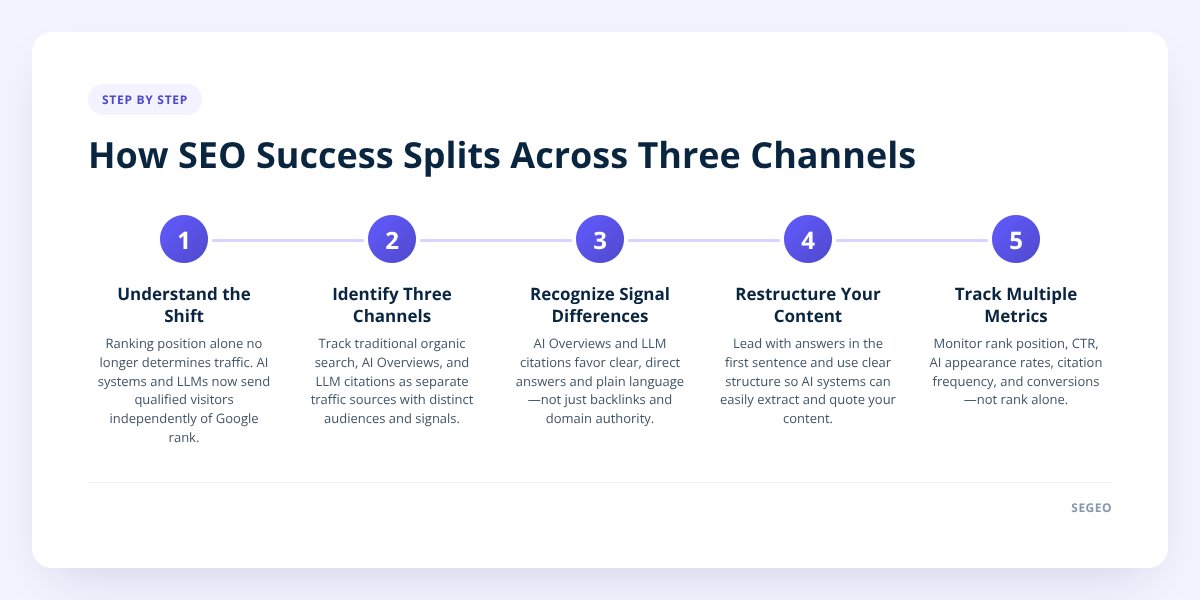
What did "ranking" used to mean, and why is that definition incomplete now?
Ranking used to mean your position on a Google results page, full stop — position 1 got the clicks, position 10 got scraps, and nothing past page one got read at all. That model worked because almost everyone searched the same way: type a query, scan ten blue links, click one. Page position was a reliable stand-in for traffic.
That stand-in is breaking down. Google itself has pushed AI-generated summaries — AI Overviews — to the top of many results pages, answering the question before the reader ever reaches the list of links. At the same time, a growing number of people are skipping Google's search box altogether and asking ChatGPT, Perplexity, or Gemini directly.
Neither of those behaviors shows up in a classic rank-tracking report. You can hold a strong position 4 or 5 for your main keyword and still watch your click volume shrink, because the person searching got their answer from an AI summary and never scrolled down to your listing. The rank number didn't lie — it just stopped being the whole story.
What are the three channels small businesses compete in today?
Small businesses today compete for visibility across three distinct channels: traditional organic search, AI Overviews, and LLM citations. Each one has its own rules, its own audience behavior, and its own way of sending (or not sending) a visitor to your site.
- Traditional organic search — the classic ten blue links. Position still correlates with clicks, and ranking well still requires the basics: relevant content, solid site structure, and real authority signals like backlinks and reviews.
- AI Overviews — the summary box Google places above or alongside search results, synthesizing an answer from several sources and linking out to a handful of them. Appearing here can earn a click even from a position that would otherwise go unseen.
- LLM citations — when ChatGPT, Perplexity, Gemini, or a similar assistant references or links to your business directly in a conversational answer, often with no "search results page" involved at all. The reader never typed a query into Google; they asked an AI assistant and got your business as part of the answer.
We laid out how these three channels diverged and what winning each one actually takes in Why Search Split Into Three Channels and How to Win. The short version: optimizing for one doesn't automatically carry over to the other two.
Why doesn't a high Google rank guarantee visibility anymore?
A high Google rank no longer guarantees visibility because AI Overviews and LLM citations pull from a different, overlapping-but-not-identical set of signals than classic ranking does. Google has described AI Overviews as drawing on its ranking systems, but the summary itself favors content that answers a question directly and clearly — not necessarily the page that has accumulated the most backlinks or the oldest domain authority.
That's how a #12 result ends up outperforming a #5 result. The #5 page might be well-optimized for keyword matching and backlink count — the traditional levers — but write in a dense, roundabout way that's hard for an AI system to extract a clean answer from. The #12 page might rank lower by classic metrics but state its answer in the first sentence, in plain language, structured so a summarization system can lift it directly.
Don't skip this: if your blog posts build up to the answer over three paragraphs instead of stating it in the first sentence, you're making it harder for every AI system — Google's Overviews included — to quote you, regardless of where you rank.
The same logic applies to LLM citations. ChatGPT and Perplexity aren't running a live Google search behind the scenes in the same way classic rank-checking tools do — they're drawing on indexed, crawlable content and favoring pages that state facts clearly, cite real specifics, and read like a trustworthy, standalone answer. We go deeper on what that structural difference means in How AI Overviews Choose Small Business Blogs.
How do you actually measure success across all three channels?
You measure success across all three channels by tracking a different metric for each one, then watching what happens after the click or citation — not just whether it happened. Rank position alone can't carry that weight anymore.
| Channel | What to track | What it tells you |
|---|---|---|
| Traditional search | Rank position + click-through rate (CTR) | Whether people see your listing and choose to click it |
| AI Overviews | Appearance rate (how often you're cited in the summary for your target queries) | Whether Google's AI considers your content a clear, quotable answer |
| LLM citations | Citation frequency across ChatGPT, Perplexity, Gemini | Whether AI assistants treat your business as a trustworthy source outside Google entirely |
| All three | Assist-to-conversion | Whether a visit that started with an AI mention or an Overview click turned into an inquiry, booking, or sale |
That last row matters more than it looks. A citation or a top rank that never turns into a phone call, a form fill, or a sale isn't really a win — it's a vanity number. Assist-to-conversion is the practice of tracing a visitor back to the channel that introduced them, then checking whether they actually did business with you. Tools like Google Search Console show impressions and clicks for traditional search; tracking AI-driven traffic usually means watching referral sources and direct-navigation spikes that correlate with new content going live, since most AI assistants don't pass clean referral data the way a search engine does.
No legitimate SEO provider — including us — can promise you'll land a specific rank or a guaranteed spot in an AI answer. What you can control is whether your content is structured, current, and clear enough to be a strong candidate across all three channels at once.
Does this change what you should actually blog about?
Yes — it means picking one channel to optimize for is now a losing strategy, because the content that wins in AI Overviews and LLM citations looks different from content that's purely keyword-optimized for classic rank. Single-channel optimization was built on the old model: pick a keyword, stuff it into a title and a few headers, build some links, wait. That approach can still nudge a classic rank up. It does very little for AI Overviews or LLM citations, which reward content that reads like a genuinely useful, well-organized answer — not a keyword target.
Omnichannel content means writing posts that work for all three audiences at once: a human skimming on their phone, Google's AI summarizer looking for a clean quotable sentence, and an LLM scanning for a trustworthy, specific answer to cite. That's a structural habit, not a one-time fix — answer the question in the first sentence, back claims with specifics, update old posts when facts change, and publish often enough that your site looks active rather than abandoned.
That last point is where most small business owners fall behind, not because they don't understand the strategy but because they don't have time to execute it daily. Writing one well-structured post is a few hours of work. Writing one every day, pulling topics from what's actually trending in your industry instead of a stale content calendar, and keeping each post distinct from the last 30 so you're building real topical coverage — that's a production problem, not a strategy problem.
That's the specific gap Segeo is built to close: it publishes a finished, on-topic post to your own site every day, picks topics from live trend data and real local-intent keywords so you're never guessing what to write about, and structures every post so ChatGPT, Gemini, and Perplexity can cite it — not just Google. It also checks each new topic against your last 30 posts so your blog builds coverage instead of circling the same five ideas, and you can run it in review mode so nothing publishes without your sign-off.
If you want to see what that output actually looks like before committing to anything, 3 Blog Post Examples That Rank in Google and Get Cited by AI walks through real structure choices side by side.
Segeo runs from $89 a month, with everything — writing, topic research, images, publishing, and social posts — included in the one plan; see current pricing at segeo.net/pricing. If daily publishing sounds like more than you can keep up with by hand, that's exactly the gap it's built to close.
Checklist: build a blog strategy that works across all three channels
- Write your answer in the first sentence of every post — don't make readers or AI systems dig for it.
- Back every claim with a specific number, date, or named source instead of a vague generality.
- Review your last 30 posts before writing a new one, and skip any topic you've already covered.
- Check Google Search Console for impressions and CTR on your key pages at least monthly.
- Watch for direct-traffic or referral spikes that line up with new posts going live — a sign of AI-driven visits.
- Update old posts when the facts in them go stale, rather than only publishing new ones.
- Set a real publishing cadence and stick to it — sporadic posting undercuts every channel at once.
- Track whether AI-driven or Overview-driven visits actually turn into inquiries or sales, not just traffic.
