
Quick answer: Posting every day helps AI search visibility only if each post is structurally clear, specific, and backed by real topical authority — volume alone doesn't earn citations from ChatGPT, Perplexity, or Google AI Overviews. What actually moves the needle is content that answers a question directly, links to related pages on your own site, and comes from a domain that already shows some depth on the topic. A daily habit without those three things is just more thin content, faster.
Key takeaways
- AI Overviews and chatbots pull answers from passages, not whole pages — a post needs one clear, quotable answer near the top to get picked up.
- Google's own guidance on E-E-A-T (experience, expertise, authoritativeness, trust) applies to AI Overviews sourcing, not just classic search rankings.
- Orphaned posts — pages with no internal links pointing to or from them — signal weak topical authority, even if the writing itself is solid.
- A site with 20 posts that thoroughly cover one niche typically out-cites a site with 200 posts spread across unrelated topics.
Does posting every day actually help SEO?
Yes, but only as a side effect of something else: consistent publishing gives search engines and AI crawlers more chances to find your site, more internal pages to link between, and more evidence that your business is active in its space. The mistake is treating frequency as the goal instead of the mechanism.
Think of it like this: a gym membership doesn't get you in shape. Showing up and doing the right exercises does. Publishing daily is the membership. Structure, depth, and internal linking are the exercises.
A lot of small business owners hear "blogging helps SEO" and translate that into "more posts equals more visibility." That's not wrong, exactly — it's incomplete. Google has said for years that content quality and usefulness matter more than volume, and AI answer engines are even less forgiving of thin content because they're not just ranking a page, they're lifting a specific sentence or two to quote directly.
Here's the practical version: a business publishing three genuinely useful, well-structured posts a week will usually out-perform one publishing seven vague ones. The daily cadence still has real value — it keeps your site fresh, gives Google Search Console more data to work with, and builds a backlog of internally-linked pages. But cadence is the delivery mechanism, not the product.
What do AI models actually look for in a source?
AI systems favor content that's specific, verifiable, and easy to extract a clean answer from — not content that's simply recent or frequent. When a tool like ChatGPT or Perplexity answers a question, it's pulling a passage it can quote confidently, attribute to a source, and trust isn't going to embarrass it. That means three things matter more than people expect:
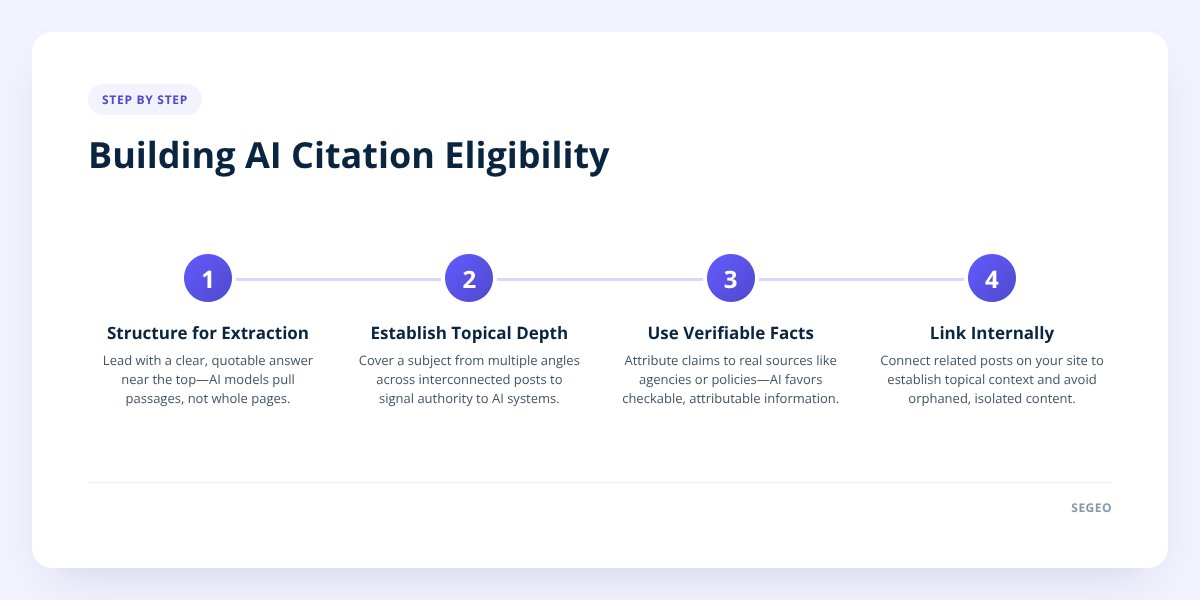
- Structural clarity. A clear H2 phrased as a question, followed immediately by a direct answer, is far easier for a model to lift than a paragraph that builds up to the point over three sentences.
- Topical depth. A site that has covered a subject from five or six angles reads as more authoritative than a site with one post that mentions it in passing.
- Named, checkable facts. Claims attributed to a real source (a government agency, an industry body, a documented policy) are more citable than vague claims with no attribution at all.
This is the same logic behind E-E-A-T — Google's framework for evaluating experience, expertise, authoritativeness, and trust — which Google's Search Quality Rater Guidelines describe as central to how content gets evaluated, and which appears to carry over into how AI Overviews select and rank sources. A post doesn't need a celebrity author to pass this test. It needs to sound like it was written by someone who actually knows the subject, with specifics instead of generalities. We went deeper on the actual page-level mechanics of this in How to Structure a Blog Post for AI Overviews Optimization.
How does Google AI Overviews pick sources differently than regular search?
Google AI Overviews leans harder on recency, specificity, and verifiability than traditional organic rankings do, according to Google's own documentation on how AI Overviews are generated from web content. Classic search results can reward a page that's been ranking well for years, even if it hasn't been touched recently. AI Overviews behaves more like a fact-checker — it wants an answer it can trust right now, which changes the calculus:
| Factor | Traditional organic search | AI Overviews / AI chat answers |
|---|---|---|
| Recency | Helpful, not required | Often weighted heavily for time-sensitive topics |
| Page authority | Domain-wide signals matter a lot | Passage-level clarity matters as much as domain |
| Specificity | Broad pages can still rank | Vague pages rarely get quoted |
| Link structure | External backlinks carry weight | Internal linking helps establish topical context |
| Format | Any format can rank | Direct-answer format gets extracted more often |
The practical takeaway: a page optimized to rank on page one of Google isn't automatically a page that gets quoted in an AI Overview or a ChatGPT answer. Those are related goals, not identical ones. We covered how to write for both at once in How to Structure Content So Google and ChatGPT Both Get It.
Don't skip this: if your post buries the answer under three paragraphs of scene-setting, an AI model will likely skip your page and quote a competitor's instead — even if your information is better. Lead with the answer every time.
Four moves that actually build AI citation eligibility
Four specific habits separate sites that regularly get cited from sites that publish constantly and get ignored:
- Narrow your niche before you widen it. A plumbing company that writes twenty posts about water heater repair builds more topical authority than one that writes twenty posts spanning plumbing, HVAC, and general home tips. Depth in one area beats breadth across many.
- Link your own authority together. Every new post should link to at least one older, related post on your site, and older posts should get updated with links to new ones. This internal web is one of the clearest signals that a domain has real depth on a topic, not just scattered mentions.
- Answer the follow-up question, not just the headline one. If your post title is "how often should I blog," a strong post also answers the questions a reader would ask next — how long should each post be, what happens if I skip a week, does the topic matter more than the schedule. That's what makes a post get cited for multiple related queries instead of just one.
- Earn citations instead of chasing keywords. A citation happens when your content is the clearest, most specific answer available — not when a keyword appears a certain number of times. Google has been explicit that keyword stuffing can hurt rather than help.
An example: a small accounting firm publishing about tax deadlines might title a post "When Is the Quarterly Estimated Tax Deadline?" A thin version answers in one line and stops. A version built for AI citation answers in one line, then covers what happens if you miss it, how the penalty is calculated, and links to a related post about which businesses need to pay quarterly at all. The second version is the one worth quoting.
Setup mistakes that quietly block AI visibility
Four setup problems keep otherwise decent businesses out of AI answers, and none of them are about writing talent:
- Thin posts. A 300-word post that restates the title in five different ways gives a model nothing distinct to extract.
- Keyword stuffing. Repeating "ai search optimization" or any target phrase unnaturally doesn't help rankings and can actively hurt trust signals, per Google's long-standing spam policies.
- Orphaned content. A post with zero internal links pointing to it — and none pointing out — looks isolated to a crawler, even if the content itself is strong.
- Weak domain authority. A brand-new domain with no history, no consistent topic coverage, and no backlinks is starting from behind, no matter how good any single post is.
These four issues compound. A thin, orphaned, keyword-stuffed post on a new domain has almost no shot at getting cited, while a well-structured, internally-linked post on an established domain has a real one. We listed the fuller set of these failure points in 8 Mistakes That Keep Businesses Out of AI Search Results.
If you're not sure where your own site stands on any of this, run a quick gut check against The AI Search Optimization Checklist for Non-Marketers — it's built for owners who don't have a marketing background and just want to know what's actually broken.
This is exactly the gap Segeo is built to close — it doesn't just publish a post to your site every day, it picks topics from what your industry is actually discussing that week, learns your brand voice from your existing site, and links new posts into your older ones so the whole blog builds topical authority instead of sitting as disconnected pages. The daily habit still matters. It's just not the whole job.
If you want that daily habit paired with the structural and linking work AI answer engines actually reward, Segeo handles both — daily posts, automatic topic selection, and the internal structure that makes a blog worth citing, starting at $89/month.
Checklist: Building AI-citable content instead of just frequent content
- Pick one narrow topic area and commit to covering it from five or more angles before branching out.
- Open each post's key sections with a direct answer, then explain the reasoning after.
- Add at least one internal link to an older, related post every time you publish.
- Go back and add links from old posts to new, relevant ones.
- Attribute any statistic or policy claim to the specific named source, not "experts say."
- Cut any paragraph that restates the title without adding a new fact or step.
- Check that no post on your site has zero internal links pointing to or from it.
- Review your last five posts for keyword repetition that reads unnatural out loud.
