
Quick answer: AI assistants skip most small business blogs because the posts lack clear author identity, bury facts in vague prose instead of citable claims, and contradict themselves across old and new content. Fix it by adding real author bylines, structuring claims as standalone statements with sources, building topic clusters instead of one-off posts, and publishing often enough that the content stays current. None of this requires a rewrite of your whole site — it's a fixable pattern, not a personality flaw.
Key takeaways
- AI assistants like ChatGPT and Perplexity favor content with identifiable authors, clear dates, and self-contained factual statements — the same qualities that make a sentence easy to quote.
- A post needs roughly 600+ words of real depth on one topic to read as authoritative; thin 300-word posts rarely get pulled into an AI answer.
- Keyword-stuffed writing actively hurts AI visibility because large language models are trained to recognize and downrank unnatural phrasing.
- Fixing this is an ongoing process, not a one-time edit — blogs that publish consistently and build connected topic clusters have a real, if unguaranteed, shot at being cited; stale ones fade out.
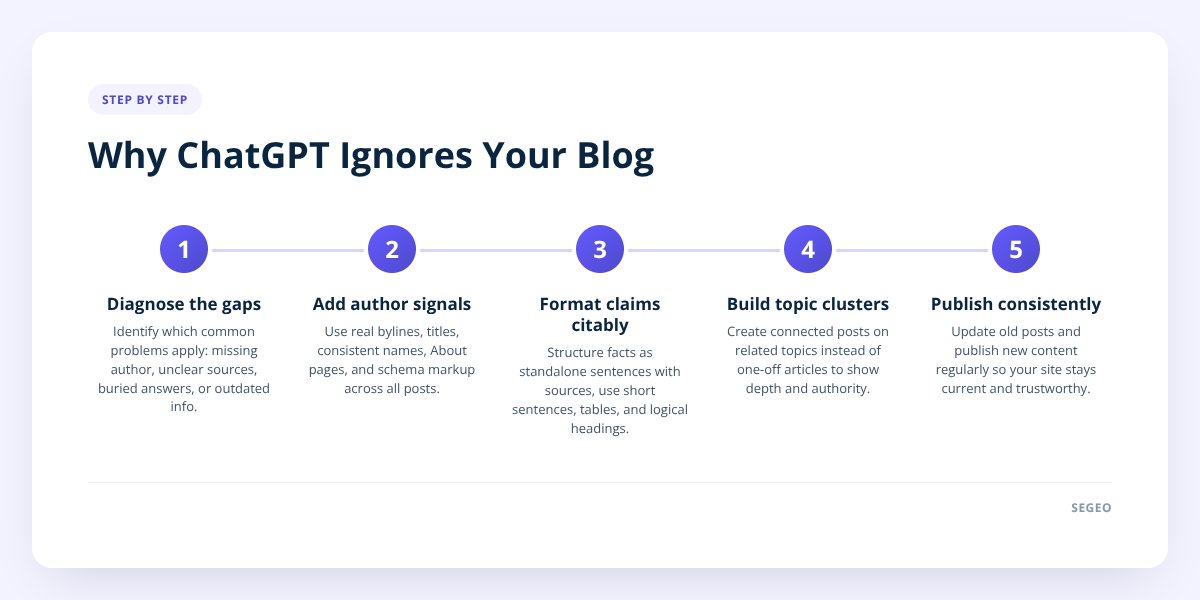
Step 1: Figure Out Why You're Being Skipped
Before fixing anything, diagnose which of four common gaps applies to your blog. Most ignored small business blogs fall into one or more of these buckets.
Missing author authority signals. If your posts are published under "Admin" or no byline at all, an AI assistant has no way to judge whether the content came from someone who knows the subject. Perplexity and ChatGPT both lean toward sources that read as credible — and a named person with a visible role is one of the clearest trust signals available.
No clear source attribution formatting. Posts that make claims without saying where the information came from ("studies show," "experts agree") give an AI model nothing to verify or quote. Contrast that with a sentence like "the IRS sets the standard mileage rate annually" — specific, attributed, and easy to lift as-is.
Content buried under noise. If your actual answer is in paragraph four after three paragraphs of throat-clearing, most AI crawlers and summarizers will grab a competitor's post that answers in sentence one instead.
Outdated or contradictory info. A 2022 post claiming one filing fee and a 2026 post claiming another, both still live, tells an AI system your site can't be trusted as a current source. When in doubt, systems default to silence rather than risk citing something wrong.
Step 2: Add the Author Signals AI Systems Actually Look For
Give every post a real name, a real role, and a reason that person's opinion matters. This is the single highest-leverage fix on this list, because it touches every post you've ever published.
A strong byline does three things an anonymous one can't:
- Names a real person with a title relevant to the topic (owner, founder, licensed practitioner, certified technician).
- States their connection to the business, so the expertise reads as earned, not borrowed.
- Stays consistent across posts, so the same name builds a recognizable pattern over time rather than a different "Team" voice each week.
Beyond the byline, a few structural signals reinforce the same message:
- Add an About page that spells out who writes or reviews the content and what qualifies them.
- Use schema markup (the structured data behind your pages) so search engines and AI crawlers can parse author, publish date, and organization automatically instead of guessing.
- Keep publish and "last updated" dates visible on every post — a model cross-checking facts will favor a post it can confirm is current.
None of this requires technical skill you don't have. If you're running Segeo, author voice and business details get pulled from your own site at setup and applied consistently to every post, which is one less thing to manage by hand.
Step 3: Format Claims So They're Easy to Quote
Structure each factual claim as a complete, standalone sentence an AI model could lift word-for-word and still make sense out of context. This is the difference between writing for a human skimmer and writing for a system that extracts individual sentences to build an answer.
Compare these two versions of the same fact:
Vague: "There have been some changes to overtime rules recently, so it's worth checking." Citable: "The Department of Labor updated its overtime salary threshold in 2024, and employers should confirm the current figure on the agency's website before classifying employees."
The second version names the source, states the fact plainly, and tells the reader what to do next — three things a citation-friendly sentence needs.
A few formatting habits make this easier across an entire post:
- Answer the question first. If a heading asks "How long does X take?", the very next sentence should give the answer — not a paragraph of setup.
- Use short, declarative sentences for facts. Long compound sentences with multiple clauses are harder for a model to extract cleanly.
- Attribute every statistic or rule to its source by name — the agency, the standards body, or your own documented process — rather than a vague "research shows."
- Use tables for comparisons. A table of fees, timelines, or eligibility rules is far easier for an AI system to parse and quote accurately than the same information written out in prose.
- Keep a logical heading structure (one clear H1, then H2s, then H3s if needed) so a crawler can map how your ideas relate to each other.
This approach — writing the kind of sentence a model wants to quote — is covered in more depth in How to Get Cited by ChatGPT, Perplexity, and Claude, if you want to go deeper on citation mechanics specifically.
Step 4: Fix the Habits That Actively Repel AI Assistants
Some common blogging habits don't just fail to help — they work against you. Here's where small business blogs tend to self-sabotage, and what to do instead.
| Mistake | Why it hurts | What to do instead |
|---|---|---|
| Thin posts (under ~400 words) | Reads as low-depth; nothing substantial to cite | Cover one topic fully — aim for genuine depth, not word count for its own sake |
| Keyword stuffing | Large language models are trained to recognize unnatural phrasing and discount it | Write the keyword once, naturally, where it fits the sentence |
| Frequent silent rewrites | Confuses version history — a model may have indexed an older claim that now contradicts the page | Note "updated" dates and keep old facts consistent, or clearly mark what changed |
| No topic clusters | Isolated posts look like one-off opinions, not coverage of a subject | Build connected posts that link to each other around one theme |
| Copy-pasted template posts | Identical structure across every post reads as generic, low-effort content | Vary structure and example per post — a model favors specific, concrete writing over boilerplate |
Don't skip this: publishing a burst of ten posts in one week and then going quiet for three months is worse for AI visibility than publishing nothing at all — it signals an abandoned, unreliable source rather than an active one.
Topic clusters deserve a second look because they're the piece most small business owners skip. One post about "how to winterize a sprinkler system" is fine. Ten connected posts — covering timing, cost, common mistakes, DIY versus professional, and regional climate differences — tell an AI system your site is a real knowledge base on irrigation, not a single lucky answer. That's exactly the kind of topical depth that's hard to fake with a once-a-month posting habit and easy to build with a daily one, which is the structural gap Segeo is built to close — it checks each new topic against your last 30 posts specifically so the blog builds coverage instead of circling the same three ideas.
Step 5: Run This Audit on Your Blog Today
Pull up your five most recent posts and check each one against this list. You're looking for patterns, not perfection on any single post.
- Confirm every post has a named author with a stated role or credential.
- Check that your most important fact or answer appears in the first two sentences of its section, not buried in paragraph four.
- Scan for at least one specific, attributed source (agency, named study, documented policy) per factual claim — not a vague "experts say."
- Search your site for contradictory facts between old and new posts on the same topic, and update or remove the outdated one.
- Count your words per post — flag anything under roughly 400 words for expansion or merging with a related post.
- Look for keyword phrases repeated more than two or three times in one post; trim anything that reads unnatural out loud.
- Check whether your last five posts connect to each other (internal links, shared theme) or read as five unrelated topics.
- Verify your publish dates are visible and your most recent post is less than a month old.
If that audit turns up more red flags than green ones, the realistic fix isn't a weekend rewrite — it's a consistent, ongoing habit most owners don't have time to sustain by hand. That's the gap daily, trend-led publishing is built for: a fresh post on-site every day, source-attributed and structured for citation, without you opening a keyword tool or writing a byline each morning.
If you want to see what citation-ready posts actually look like in practice, 3 Blog Post Examples That Rank in Google and Get Cited by AI walks through real structure side by side.
Run the five checks above this week. If your blog needs more consistency than you can give it by hand, see how Segeo handles daily publishing, topic selection, and citation-friendly structure automatically, or check current plans on the pricing page.
Checklist: Auditing Your Blog for AI Visibility
- Add a named author with a title to every post, past and present.
- Rewrite your top three posts' opening sentences so the answer comes first.
- Attribute every statistic or rule to its named source in the sentence itself.
- Find and resolve any contradicting facts between old and new posts.
- Expand or merge any post under roughly 400 words.
- Remove repeated, unnatural keyword phrases from your last five posts.
- Link related posts to each other to form a visible topic cluster.
- Confirm your most recent post is less than a month old.
